Seafaring has always been a demanding and high-risk occupation. Long voyages, harsh weather conditions, illness, and accidents can take a heavy toll on crew health, while making it easy to overlook a much smaller threat: the mosquito. Seafarers are often isolated from the medical care and support available ashore, and the mosquito’s ability to rapidly spread serious and potentially fatal diseases makes it a significant health threat. Malaria and dengue fever are the most common mosquito-borne diseases and the ones most likely to affect seafarers. However, sporadic and local outbreaks of other diseases, such as yellow fever, chikungunya and Zika, may also pose a risk to crews during port calls and coastal operations.
Managing infectious diseases
All types of infectious diseases pose a serious risk to seafarers’ health and can result in significant cost and operational disruption for maritime employers. Effective preventive measures are therefore essential. In many cases, onboard control measures focusing on personal hygiene, sanitation, and isolation practices will reduce the risk of transmission.
Mosquito-borne diseases present a different challenge. Unlike many other infections, diseases such as malaria and dengue do not spread directly from person to person. Instead, transmission requires a mosquito as vector to carry the virus or parasite between humans. As a result, hygiene measures alone are insufficient to control the risk. Effective prevention of mosquito-borne diseases require supplementary measures, including insect bite avoidance, environmental controls, preventive medication in the case of malaria, and vaccination programs where available.
The risk of contracting any infectious disease, and particularly a mosquito-borne disease, will depend on several ship and voyage specific factors and onboard requirements must be determined by assessing:
the route of the ship, especially the location of ports visited, length of stay and likelihood of exposure ashore either on shore leave or when joining or leaving a ship,
known health risks in the country of origin of seafarers and countries passed through en route to joining or leaving the ship, as well as
each seafarer’s role and work tasks.
It is a ship operator’s responsibility to establish an effective procedural system for, and create awareness on, the risk of infectious diseases in general, and mosquito-borne disease transmission in particular. It must be ensured that seafarers are familiar with the signs and symptoms of the most common mosquito-borne diseases, understand that these diseases are serious and potentially fatal, and implement prevention measures when their ship is destined for areas where there is a potential risk of being infected.
Mosquito-borne diseases affecting shipping – fast facts
The global burden
Mosquitoes may be the deadliest animals in the world as their ability to carry and spread disease leads to hundreds of thousands of deaths every year. Major trade routes pass through areas affected by mosquito-borne diseases, putting seafarers at risk. Exposure to mosquito bites and the resulting rates of infection will vary within a single country and with the seasons. The latest official advice should therefore be checked every time a ship is destined for areas where there is a potential risk of mosquito-transmitted diseases.
At the time of writing, the WHO reports that:
Malaria remains a major cause of illness and death in many low-income countries. In 2024, an estimated 282 million cases were reported across 80 malaria-endemic countries, resulting in about 610,000 deaths. While the disease is most common in tropical and subtropical regions, it is not limited to these climates and can occur wherever conditions support transmission. Malaria risk is strongly influenced by environmental factors such as altitude and climate, including temperature, humidity, and rainfall. Although malaria‑endemic countries exist in all WHO regions except Europe, the burden is highly concentrated in the African Region, which accounts for 94 percent of global cases. Within this region, half of all malaria‑related deaths occur in just three countries: Nigeria (31.9%), the Democratic Republic of the Congo (11.7%) and Niger (6.1%).
The global incidence of dengue has increased dramatically over recent decades. In 2000, approximately half a million dengue‑related cases were reported worldwide. By 2023, this figure had risen to 6.5 million cases and more than 7,300 deaths. In 2024, sustained transmission combined with an unexpected spike in cases resulted in a historic high of over 14.6 million reported cases and more than 12,000 dengue‑related deaths. Traditionally confined to tropical and subtropical regions, dengue is now spreading into new areas as climate change and rising global temperatures enable mosquito vectors to expand their geographic range. In 2024, the WHO received reports of 308 cases from three European countries, France, Italy, and Spain, and dengue transmission has now been documented in all WHO regions. The Americas remain by far the most affected region, followed by South‑East Asia and the Western Pacific.
Yellow fever and chikungunya are both diseases that can be fatal and have caused serious outbreaks in recent years. Yellow fever is primarily found in Africa and Central and South America. However, because the disease is preventable through a highly effective vaccine, substantial progress has been made in reducing its spread and overall impact. Despite this, yellow fever remains a significant threat to global health security due to its severity and potential for international spread. Chikungunya, by contrast, continues to expand geographically, although serious complications are relatively uncommon. The disease occurs mainly in Africa, Asia and the Americas, but transmission has also been reported in Europe in recent decades.
The Zika virus was largely dormant for nearly six decades before major outbreaks were recorded in 2015 across Africa, the Americas, Asia and the Pacific. Although cases have declined since 2017, transmission persists at low levels in several countries in the Americas and in some countries in Asia and Africa, where sporadic outbreaks have also been documented. While most people infected with the Zika virus do not develop symptoms, infection is associated with an increased risk of neurological complications in both adults and children, including Guillain-Barré syndrome, neuropathy and myelitis.
The nature of the diseases
The mosquito that transmits malaria, the Anopheles mosquito, is active mainly at night, between dusk and dawn. Zika, dengue, chikungunya and yellow fever, on the other hand, are primarily transmitted through the bites of an infected Aedes mosquito which also bites during daylight hours. Zika can also be sexually transmitted from one person to another.
A seafarer infected by any of the common mosquito-borne diseases may initially experience mild non-specific symptoms similar to those of influenza and other febrile illnesses. However, as severity and treatment vary between the diseases, immediate medical attention should be sought to ensure early diagnosis. Information that may assist in diagnosis has also been published by the WHO and is reproduced below.
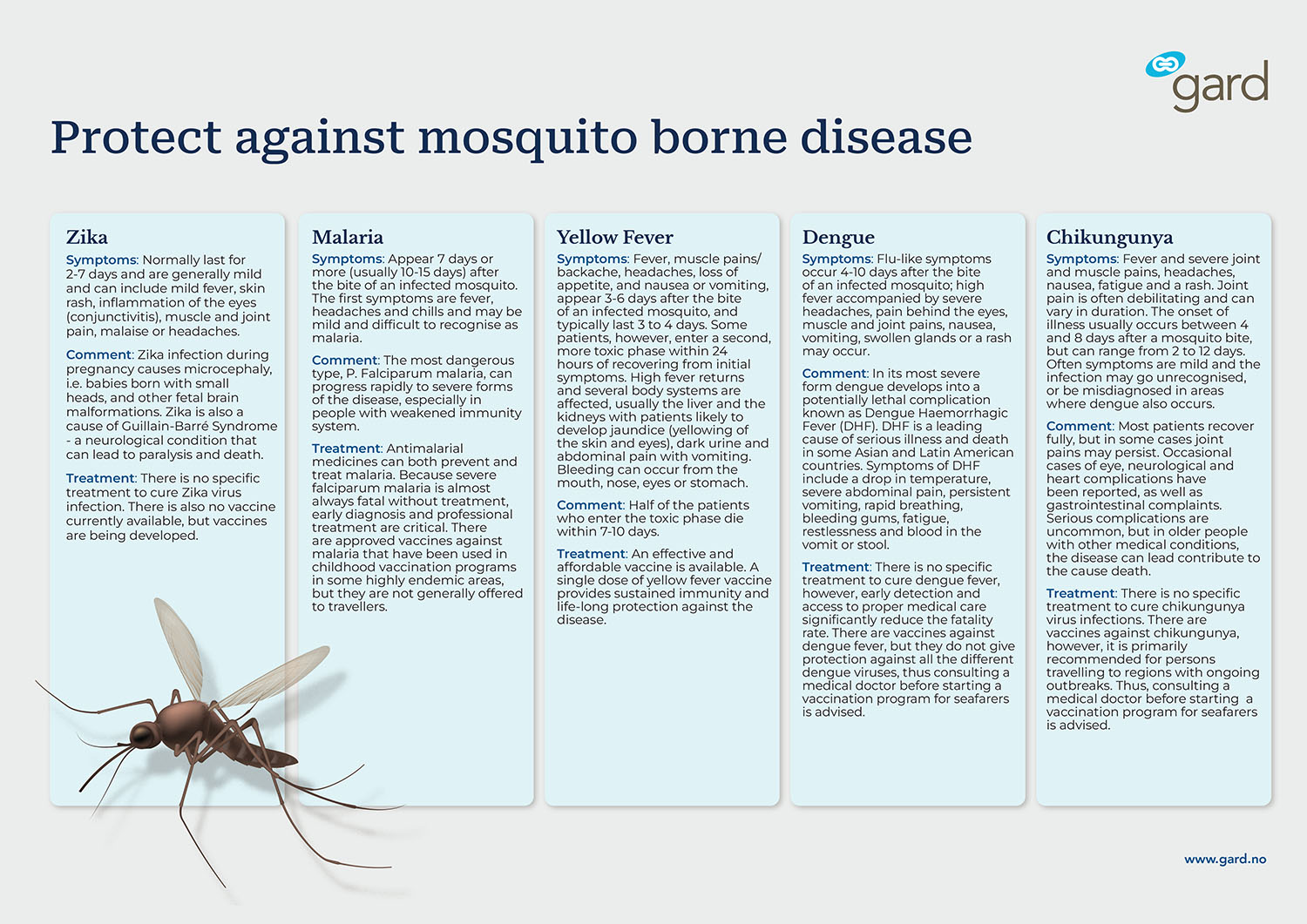
Click here to enlarge the above illustration.
Recommended precautions
Owners and operators with ships trading within mosquito zones should ensure that the crew onboard these ships are able to deal with the various challenges that these diseases can bring. As far as practicable, they should tailor make their own strategies for dealing with risks associated with infectious diseases and for mosquito-borne diseases in particular, the following should be considered:
Prior to visiting affected areas
Monitor the WHO website and similar sources for official advice regarding any ongoing outbreaks. Contact a medical practitioner if in doubt.
Review all the ports to be visited and evaluate the risk for each port. Consider the length of stay in an affected area, time spent at sea, in port and on rivers, as well as planned shore leaves by the crew.
Inform the crew about the risks and the precautions to be taken as well as actions to be taken if illness occurs at sea. Stress that a headache, fever and flu-like symptoms are always grounds for contacting the medical officer.
Ensure sufficient supplies of effective insect repellents, light coloured boiler suits, porthole/door mesh screens and bed-nets.
Consider, in close co-operation with a medical doctor and based on the ship’s expected exposure time in an affected area, if the crew should take a specific vaccine and/or an antimalarial drug. Considerations for the type of antimalaria drug to be used should include efficacy, local resistance patterns, simplicity of dosage schedule, and possible adverse effects of the medication.
Ensure that all crew members carry valid yellow fever certificates. As a precaution, check with the ship’s agent that local port health inspectors are aware of their country's official position regarding yellow fever vaccination requirements and will recognise the amended IHR and yellow fever vaccinations with lifetime validity.
Stay up to date on new vaccine programs that may be relevant for seafarers.
During a visit to affected areas
Implement measures to avoid mosquito bites, e.g. wear protective clothing, stay in air-conditioned screened accommodation areas, use undamaged insecticide-treated bed-nets in sleeping areas. Use effective insect repellents on exposed skin and/or clothing as directed on the product label and when using a sunscreen, the recommendation is to apply sunscreen first, followed by repellent.
If crew members are taking anti-malarial drugs, implement a method of control to ensure they take the medication at the prescribed times, e.g. via a logbook.
Remove pools of stagnant water, dew or rain in order for the ship not to create its own mosquito breeding grounds. Pay particular attention to areas such as lifeboats, coiled mooring ropes, bilges, scuppers, awnings and gutters.
After a visit to affected areas
Seek medical advice over the radio, particularly if malaria or dengue is suspected on board. Normally, the ship is in port only for a short time and will most probably be back at sea when symptoms are noticed due to an incubation period of several days.
Place the patient under close observation and administer the necessary onboard care, preferably in close co-operation with a medical doctor. Normally, this will include bed rest, plenty of fluids, and easing of symptoms such as fever and muscle pain. Always consult a doctor before giving antimalaria medication and avoid the use of NSAIDs unless dengue can be ruled out, to reduce the risk of bleeding complications. Evacuation may be the only solution if the patient’s condition does not improve.
As a Zika infection during pregnancy can cause microcephaly, i.e. babies born with small heads, all seafarers concerned about a pregnancy, males and females, are advised to consult a health care provider for counselling after exposure to Zika virus.
Additional Resources
Prevention requires vigilance so stay up to date! For medical officers, we recommend consulting the diseases section of the Mariners Medico Guide app to obtain up to date medical information and treatment support for different mosquito borne diseases. General preventive measures are also highlighted in the injury section of the guide addressing insect bites and stings.
Here are some additional recommended sources of information:
Detailed information about each mosquito-borne disease - its characteristics, treatment, prevention, geographical distribution and recent outbreaks - is available via WHO’s “Health topics”.
The United States Centers for Disease Control and Prevention (CDC) provides similar information via its “Disease & Conditions A-Z Index”.
The CDC’s general “Destination List” can be a good starting point for a voyage specific risk assessment related to mosquito-borne diseases.
The International Seafarers’ Welfare and Assistance Network (ISWAN) offers guidelines and posters for malaria prevention onboard merchant ships.
National governments may also publish safety alerts concerning seasonal outbreaks of the diseases on their “safe travel” websites. Relevant information can also be obtained from medical doctors and local vaccination offices.