Electricity is essential to shipboard operations, but an electrical fault or unsafe working practice can have fatal consequences. Gard cases show that serious electric shocks often happen during familiar jobs such as using when using portable lights, grinding or welding tools or repairing electrical equipment.
Written by

Mark Russell
Vice President, Global Claims Lead, Safer with Gard

Kenneth Fjeldstad
Claims Executive

Betty Kalomiri
Senior Claims Specialist, People Claims
Published 02 November 2026
An electric shock can cause burns, serious injuries, even death. The outcome depends on factors including the voltage, the amount of current, as well as the path and time that the current takes to pass through the body.
It does not take a large current through the body to cause serious harm. The US Occupational Safety and Health Administration notes that currents above 10 milliamperes can cause involuntary muscle contractions. At higher levels, consequences can include extreme pain, respiratory arrest and possible death. The rhythmic pumping of the heart ceases at around 1 amp.
Voltage also matters because it helps drive current through resistance. Electrical systems on ships operate at different voltages, from low-voltage signal equipment to switchboards operating above 1,000 volts. Generally speaking, care should be exercised when the voltage exceeds 50 volts. The actual danger depends on the circumstances, including the condition of equipment, the electrical system and the environment in which work is carried out. Water, sweat and humidity all increase conductivity on the body's surface, thus increases the risk on ships.
The risk points onboard
Ships have several electrical distribution systems and voltages vary from as low as 5 volts for signal power to well over 1000 volts in switchboards. This is typically stepped down to 440 volts for machinery and 220 volts for lighting and sockets used for portable equipment.
The Liberia Maritime Authority (LMA) recently published a Marine Advisory on the prevention of electrocution casualties with particular emphasis on portable electrical equipment. A review of Gard cases draws many parallels with the LMA Advisory, as outlined in the below examples.
Lighting
Portable lights were the main feature of the LMA’s case studies with portable lights connected to the shipboard power supply. In one Gard case a crew member died using a portable lamp for cargo operations. The investigation found that the light was incorrectly wired, resulting in the light housing being energized.
Further insights into similar accidents can be found in this flag state report, one of which identified a joint in the lamp’s electrical cable that had been wrapped in electrical tape and in another the use of a “homemade” cable. There is a very high risk of electrocution upon touching an improperly wired metal object, with the human body becoming the path of least resistance for electricity to reach the ground.
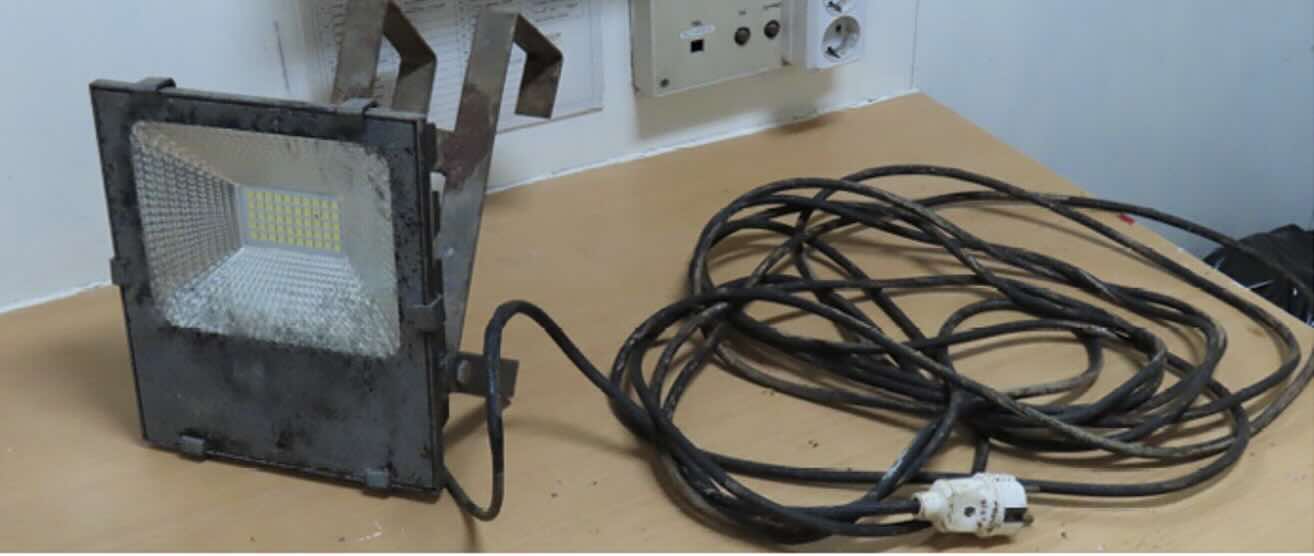
Portable lamp and cable
In another Gard case, a senior crew member died repairing fixed lighting in the accommodation without first isolating the electrical supply. The UK’s Code of Safe Working Practices (COSWP) references the Lock Out Tag Out (LOTO) safety procedure that ensures power sources are properly isolated, shut off and cannot be started up again before work on live systems is completed. RightShip’s Safety Insight refers to an underutilization of this safety protocol based on inspections.
Grinding
Portable angle electric grinders are another well used tool on board for rust removal, weld preparation, and cutting metal. In one Gard case, a crew member died due to electrocution using a grinder for routine maintenance. The investigation pointed to an electrical fault with the tool.
A flag state investigation into another accident with a grinder references an electric shock before the crew member suffered a fatal cut from the grinder. The investigators considered the possibility of electric shock causing muscle spasm. As mentioned above, muscle contractions can mean the person cannot 'let go' and the shock can cause involuntary reactions.
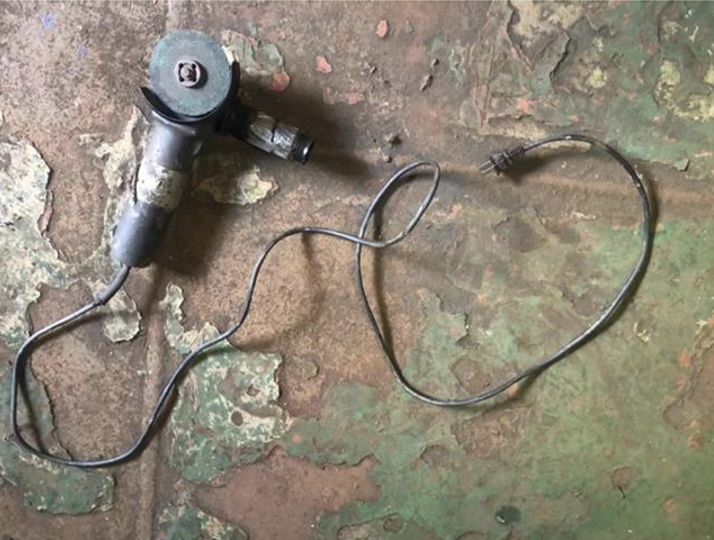
Portable grinder
Welding
Welding is another common activity onboard, which had fatal consequences for one crew member in a Gard case. The work task was to repair a pipe leak in the engine room. After the work was completed, a member of the work team was discovered alone and unconscious with burn injuries. The welding machine had not been switched off, and the deceased crew was found on the steel deck, missing some personal protective equipment (PPE).
A flag state investigation into another fatal accident involved a welding repair to railings on the main deck. Although proper PPE was worn, intermittent rain showers before and during the hot work were considered the probable cause of the electrocution. The welding machine was an older type using AC power with an idling voltage of more than three times the recommended level. UK COSWP was referenced in the vessel’s SMS and recommends welding machines with a DC rather than AC output. If DC cannot be used, UK COSWP requires a voltage-limiting device.
The investigation also identified an unsafe cable set-up. The return cable, which should have been clamped directly to the workpiece to limit the area carrying current, was instead connected to the welding machine’s storage rack in the forecastle. This significantly increased the area exposed to electric current.
The danger to first responders
In some accidents, first responders have also suffered an electric shock. Much like enclosed space rescues, responder safety must take precedence over instinct. Electrical power sources should be isolated before tending to the injured person.
For further guidance on responding to someone suffering an electric shock, see the Mariners Medico Guide.
Performance Influence Factors (PIFs)
PIFs are human factors that may enhance or diminish performance. Applying industry recognised PIFs to the above referenced electrocution cases, offers the following insights:
Recognising safety criticality. Electrical hazards can be underestimated during routine work. This reflects the finding in Gard’s 2026 Crew Claims report that most injuries happen during planned, everyday operations. Risk assessments should consider electrical hazards, particularly when using equipment in wet, damp or humid conditions. There should be no assumption that portable tools will always be safe to use, especially those subject to wear, tear, and rough handling. LMA’s Advisory also pinpointed the risks associated with manually relocating portable lamps whilst still energized, pointing to a need to reinforce crew training and risk awareness.
Follow safe procedures. Power should be isolated before working on electrical equipment, and appropriate PPE used when required. Experience alone does not prevent accidents. Inspections and audits should therefore check whether actual working practices match written procedures.
Clear and understandable procedures. In some cases, SMS procedures were limited to managing risks with higher voltage fixed equipment and were otherwise vague in relation to portable equipment. Procedures for portable equipment should include appropriate inspection, testing and maintenance by competent personnel. Maintaining a register of portable electrical equipment can support this.
Team dynamics and communications. In several cases the crew members were alone when they were electrocuted, bringing into question the adequacy of supervision or, where necessary, the requirements of a Permit to Work. Working alone can result in delayed discovery and first aid. Good communication is especially important when electrical isolation is remote from the worksite. Crew should also feel empowered to question unsafe conditions and to exercise stop work authority.
Stress, workload, fatigue. These factors are often overlooked in accident investigations, and fatigue was positively ruled out in only one reported case. In another, documented hours of rest complied with STCW/MLC requirements; however, records may not always reflect actual conditions experienced by crew. Some of the accidents occurred in the morning when Gard’s Crew Claims Report found the highest concentration of injuries. Operational pressures, adjustment, and fatigue may all play an important role in accident risk during morning hours.
Motivation to get the job done. These are also factors that can be overlooked in investigations and may affect decision making skills. In one case, a senior rank left the afternoon break to re-start work alone, perhaps motivated to get the job done sooner rather than later.
Workplace ergonomics, including signage, tools, layout, space, noise, light, heat, etc. The UK COSWP recommends low-voltage (max 50 volt) supplies for portable tools and lamps, especially for work locations that are damp, humid or have large conductive surfaces. When it is not practical to use low voltages, UK COSWP references alternative precautions. These include Residual Current Device (RCD) protection, which monitors and detects electricity flowing down an unintended path and quickly switches off the electricity.
Human-Machine Interface (Controls, Alarms, etc.). Electrical equipment differs from ship to ship and electrical standards vary across countries. This can be particularly relevant for portable equipment and crew must understand how individual safety features work and are maintained.
Opportunity to learn and practice. The gap between basic theoretical training and real-world task execution can be critical given the unseen risk of electrocution. A Walk Through or Talk Through process together with a competent colleague can make all the difference. Fostering a psychologically safe culture of trust where employees can ask questions and report mistakes is also important for continuous organizational learning.
Conclusion
Accidents featured in this article speak to the unseen – and sometimes fatal – risk to crew from electrocution. The risk arises during planned, everyday operations, and with commonly used tools or electrical systems with well-known dangers.
Crew performance during these operations is usually influenced by wider factors and is rarely rooted in a sole mistake. Companies are encouraged to seek out and understand these factors, especially from accidents or near misses with less severe outcomes but high severity potential. The insights will help to manage risks in future operations through safety leaders onboard. Ultimately however, everyone has a role in safe work. All individuals involved in a task should take time to consider whether it involves electrocution risk, as well as the factors putting themselves and others more at risk. A final pause to imagine the consequences of not taking the right steps can be a lifesaver.
Gard is a member of