General Average is one of the oldest principles of maritime law. It is an equitable doctrine that shares among property owners of the assets involved in maritime adventures the cost of extraordinary sacrifices or expenses incurred to avert a peril threatening the whole voyage. This article explains how it works, how to manage the process, and how shipowners can protect their interests - from the moment General Average is declared through to the final recovery of contributions.
Written by

John Martin
Senior Vice President, Claims Asia, Managing director

Khairul Nizham
Claims Executive
Published 02 July 2026
Although General Average applies by law, contracts of carriage usually incorporate the York-Antwerp Rules, which govern how the parties’ rights are adjusted. Rule A.1 defines general average as follows:
“There is a general average act when, and only when, any extraordinary sacrifice or expenditure is intentionally and reasonably made or incurred for the common safety for the purpose of preserving from peril the property involved in the common maritime adventure.”
Examples of circumstances that may lead to a General Average situation:
Groundings
Fires
Collisions
Machinery Breakdown
The party making the sacrifice or incurring the expense, both of which are intentional in nature, may recover contributions from the other parties. Contributions are based on the value of the property saved at the end of the voyage.
Property normally at risk includes:
The ship
The cargo
Bunkers
Containers
Freight
For example, if cargo is jettisoned to save the voyage, its owners may recover from the owners of the ship and other property at risk. Likewise, if a grounded ship incurs towage or salvage costs to refloat and save the cargo, the shipowners may recover contributions from the cargo and other property at risk.
Declaring General Average: When and How
General Average “GA” can be declared at any time. However, it should be declared before releasing the cargo, otherwise, shipowners may be unable to obtain GA security from cargo interests since the shipowner is no longer able to exercise their lien on the cargo.
Owners customarily appoint an Average Adjuster who will assist in the GA security collection and who will issue a GA Adjustment. To secure release of the cargo, the cargo owners will have to put up a GA Bond. In addition, if the cargo is insured, a GA Guarantee is collected from the cargo insurers. In the absence of any cargo insurance, a cash deposit will be collected from the cargo owners.
The Average Adjuster will appoint a GA surveyor to objectively assess the extraordinary costs or sacrifice incurred for the purpose of preserving the common maritime adventure.
Conditions for costs and/or sacrifice to qualify as General Average:
Must be an extraordinary sacrifice or expenditure.
Must be incurred in the interests of common safety.
Undertaken to preserve the property involved in the common maritime adventure from a grave and imminent peril.
Must be intentional, reasonable and achieve a measure of success.
Examples of General Average Sacrifices and Expenditures
General Average sacrifice includes:
The jettison of cargo carried on deck or the discharging of cargo overboard;
Damage to machinery and/or the ship’s bottom and the loss of equipment intentionally incurred during attempts to refloat the ship;
The loss of freight at risk due to jettison of cargo.
General Average expenditure normally includes the cost of:
Salvage
Lightening the vessel to enable it to be refloated or repaired;
Repairs necessary for the safe prosecution of the voyage;
Forced discharge of cargo to enable repairs necessary for the safe prosecution of the voyage;
Detention expenses at a port of refuge;
The costs of entering and leaving a port of refuge;
In certain jurisdictions payments of ransom to release ships and cargoes that have been detained by pirates.
However, loss or damage sustained by the ship or cargo because of delay does not qualify in General Average.
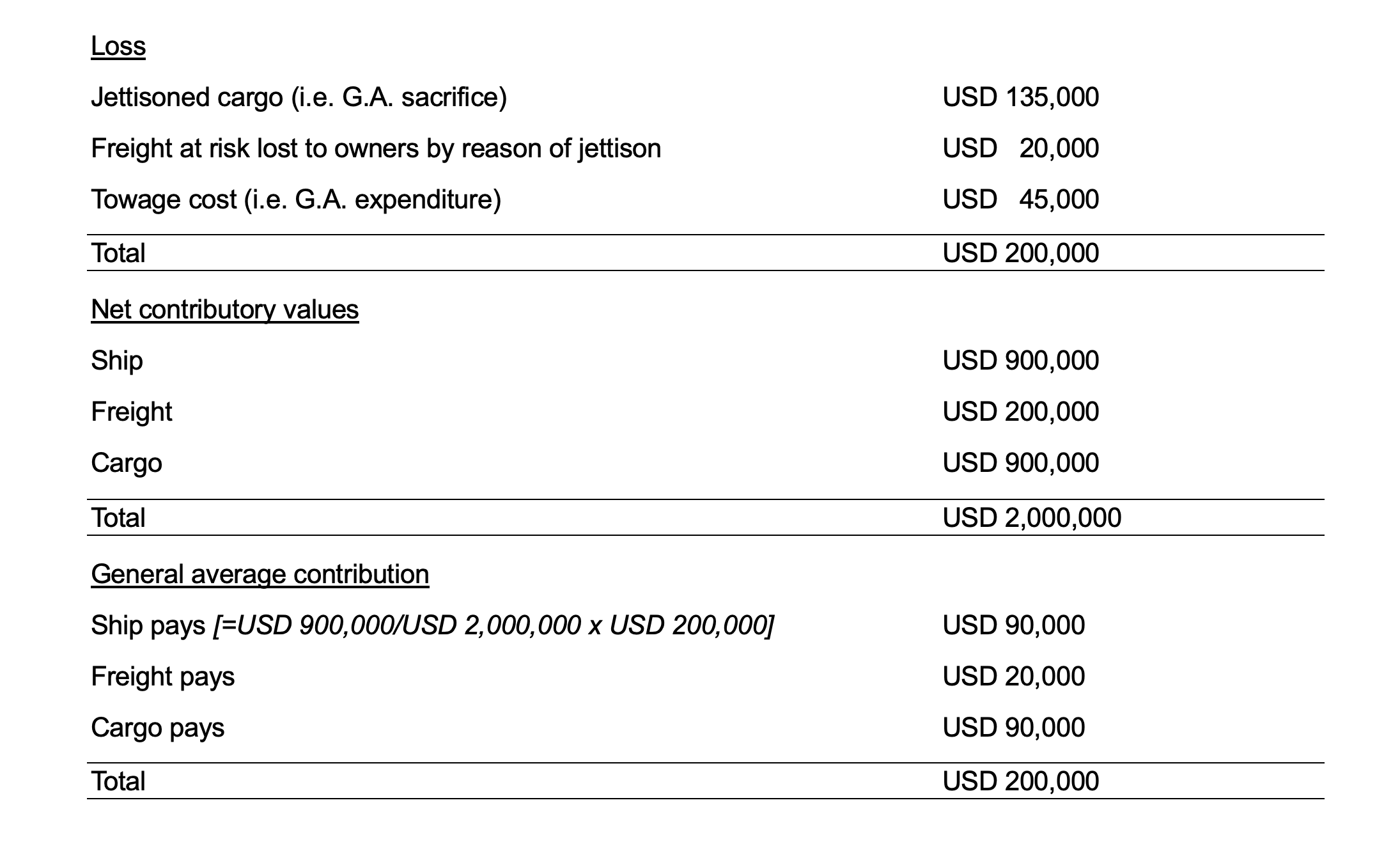
The GA Adjuster prepares the GA adjustment by including all the allowable GA sacrifices and expenses, establishes the respective net values of the property saved, and apportions the GA between the respective interests.
The following is a simple example of an adjustment:
Collecting GA Security and GA Contributions
The GA security received from cargo interests, i.e. the GA bond from cargo owners which is supported by the GA guarantee from their insurers, contains a promise by the signatory to pay the appropriate contributions upon completion of the adjustment.
Under Rule D of the York Antwerp Rules (which are customarily incorporated into all B/Ls and Charter Parties) issues of fault in the conduct giving rise to a General Average act are not taken into account, but the parties retain any legal remedies regarding that fault. Where the contract of carriage excludes liability for that conduct, it will generally not be treated as fault for this purpose, and the claimant will ordinarily remain entitled to GA contribution. The practical effect of Rule D is that the parties to the voyage can resolve the emergency situation and collect GA security without having to consider issues of who was at fault, which is resolved at a later stage.
Therefore, if a collision occurs due to the negligent navigation of the master, and it becomes necessary to run the ship aground in order to prevent her foundering, the shipowner is likely to be entitled to claim contribution from the cargo towards the cost of any towage or salvage that may be necessary to refloat the ship. This arises since a carrier has no liability for negligent navigation under Article IV Rule 2 (a) of the Hague or Hague-Visby Rules, where they apply to the contract of carriage. However, if the contract of carriage is subject to the Hamburg Rules, the carrier has no defence for negligent navigation with the result that he is unlikely to have the right to receive GA contributions.
The Role of P&I Insurers
P&I insurers will normally provide cover for the following claims:
General Average contributions which are not recoverable from cargo or other interests because of the shipowner’s breach of the contract of carriage;
General Average contributions from the ship which are not recoverable under the H&M cover of the ship (including any excess liability policy) because the ship is underinsured under standard H&M policies. However, such cover may be available only if the P&I insurer exercises its discretion to provide cover in the particular case.
It is not unusual for the preparation of a GA adjustment (and subsequent litigation) to take a number of years. Therefore, where the shipowners’ efforts to recover contributions have failed or are unlikely to succeed without significant delay, P&I insurers may have the discretion to advance funds to shipowners in appropriate cases, subject to the shipowners providing counter security in the event that the insurers are entitled to recovery of the advance subsequently.
Salvage: Managing the process and Related Costs
It is strongly recommended that Shipowners contact their insurers immediately when the need for Salvage arises. Experienced marine insurers and their legal and other advisors will provide advice on the best contract options for the particular set of circumstances faced by the maritime adventure. Lloyds Open Form (LOF) is a longstanding and familiar salvage contract, but it is not always suitable for every salvage situation and other more cost-effective contracting options must be explored, for instance Wreckhire, Wreckstage, Towhire, UK Towcon etc.
Insurers will ensure technically qualified representatives attend on site as soon as possible to oversee salvage operations, and Salvors themselves typically will report daily. However it is recommended for the owners and their insurers to cooperate closely and maintain regular contact with the Salvors – both in their head office and on site – to ensure optimal solutions are pursued in a timely and cost-effective manner.
Protecting Shipowner’s Interests in the Recovery of GA Contributions
Whilst some General Average situations are straightforward in terms of causation and sequence of events, many are complex and highly technical scenarios which involve failing or improper operation of the ship’s equipment or machinery, or cargo which has ignited, self-combusted, or malfunctioned. As such, they often lead to contentious technical arguments, and GA contributions may be disputed by the contributing interests, in particular cargo interests.
Shipowners have the fallback position of P&I cover in the event that cargo refuses to pay on the grounds of unseaworthiness. However, it is strongly recommended that Shipowners keep a daily log of all events that occur around the casualty and in the case of a technical failure, maintain all damaged machinery parts or remains of cargo which may ignited, plus technical, maintenance records, classification and manufacturers reports from both before and after the casualty. This will help the H&M insurers, GA adjusters, P&I Club, and their respective technical and legal advisors identify the true cause of incidents and ensure the correct recovery is made.
Lessons Learned and Best Practices for Shipowners
General Average situations are usually emergencies and can be challenging foremost for the crew, but also for the Shipowners, and for shore-based personnel affected by the incident. Supporting the crew and those other staff directly involved in particular is paramount.
Shipowners are almost always the principal handlers of a GA situation, but they should look to fully use and cooperate with their insurance, legal and technical advisors. Specialist H&M and P&I insurers have dealt with multiple GA and related scenarios, and will be able to provide expert guidance on the necessary steps.
Evidence is key in the handling and the aftermath of GA situations and evidence which is not retained has a habit of dissipating quickly, especially if the GA occurs in a foreign jurisdiction. Shipowners should also document all processes to the fullest extent possible, and retain key documentation including manufacturers reports and technical assessments, quotations and tenders, repair bills, Class reports, cargo records, deck and engine room logbooks etc. If in doubt, consult your insurers.
Related Articles


Gard is a member of