Hydrogen sulphide (H₂S) is well recognised as one of the most dangerous hazards associated with enclosed spaces on board ships. However, recent casualty investigations demonstrate that the greatest danger may arise before anyone enters the space.
Written by

Published 14 October 2026
A review of fatal incidents submitted to the IMO shows that many seafarers were overcome by H₂S while carrying out routine maintenance and inspection activities outside enclosed spaces. Crew members have collapsed while opening tank manholes, dismantling pumps and pipelines, working near tank vents, and attempting to rescue colleagues. In many of these incidents, the victims had no intention of entering a tank. The findings highlight an important safety message: H₂S should not be viewed solely as an enclosed-space entry hazard. It is also a release hazard. Personnel can be exposed during everyday shipboard operations whenever a contaminated system is opened, disturbed or ventilated.
More than half of fatalities happened outside
According to IMO document CCC 12/INF.20 (10 July 2026), at least 29 of 56 identified H₂S-related fatalities occurred outside enclosed spaces. The victims were carrying out routine tasks when a sudden release of H₂S caused immediate collapse.
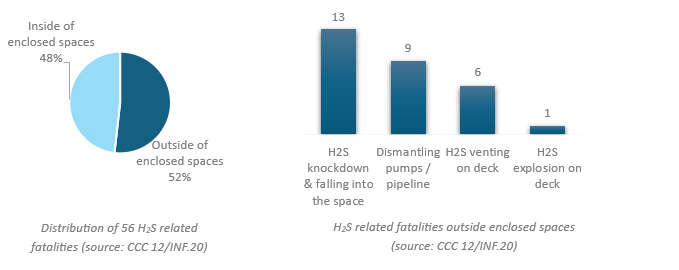
These findings challenge the traditional perception that H₂S fatalities are primarily linked to enclosed-space entry. A hazardous gas release can also occur during normal shipboard operations, as the following case study illustrates.
Case study: fatal exposure while opening a bilge water tank
Before cleaning a bilge water tank on a drillship, a Second Engineer (2/E) and a Motorman opened the tank access hatch to allow for ventilation. Moments later, as he was climbing away from the hatch, the 2/E suddenly collapsed, and both men fell into the tank. Tragically, despite rescue efforts, both men lost their lives.
The investigation found that the tank contained oily water and residue deposits capable of generating H₂S. Opening the hatch likely released accumulated gas into the surrounding pump room, exposing the workers before any tank entry had begun. The incident highlights a crucial point: simply opening a tank can release a potentially fatal concentration of H₂S.
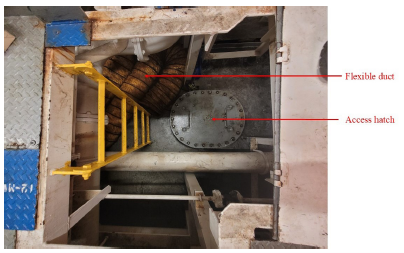
Image shows the access hatch and ladder for accessing the tank top in the Aft Pump Room. Source: Valaris DS-17 Marine Safety Investigation Report (2023), Republic of the Marshall Islands.
What is H₂S knockdown?
H₂S knockdown refers to the sudden collapse and loss of consciousness that can occur following exposure to very high concentrations of hydrogen sulphide. H₂S is a colourless, highly toxic, and flammable gas. It is heavier than air and tends to accumulate in low-lying areas such as tank bottoms, bilges, pits, and poorly ventilated spaces.
While low concentrations may produce the characteristic smell of rotten eggs, this odour cannot be relied upon as a warning. Exposure can rapidly paralyse the sense of smell, leaving individuals unaware that concentrations are increasing.
At concentrations of approximately 700-1,000 ppm, a person may collapse after only a few breaths. Respiratory paralysis and death can occur within minutes. In such situations, portable gas detectors may provide little practical warning if the release is sudden or exceeds the detector's measuring range.
How does H₂S develop?
H₂S is commonly generated when organic or oil-containing materials decompose under oxygen-deficient conditions. On board vessels, the combination of seawater and organic or oily residues can create ideal conditions for sulphate-reducing bacteria to produce H₂S. Potential sources include:
Oily slops and sludge
Sewage and grey-water systems
Fuel oil residues
Food waste and organic wash water
Bilges and bilge holding tanks
Cargo residues
Contaminated ballast tanks
Even small quantities of seawater mixed with these materials can generate significant concentrations of H₂S. Biodegradable detergents and nutrient-rich wastes may further accelerate the process. A particular challenge is that H₂S may remain dissolved within liquids and only be released when conditions change, such as when a tank is opened, contents are agitated or pumped, tank washing begins or pressure conditions change. As a result, a space that appears safe may suddenly release a concentrated cloud of gas during an otherwise routine operation.
Preventing H₂S knockdown
The first control is to recognize tank opening, opening a pump or a pipe, and disturbance of residues as potential toxic-gas release operations. The risk assessment should address both the source space and the surrounding or connected space.
Assess before opening: Check the space’s history and contents, including previous storage of sewage, grey water, oily water, slops, cargo residues, seawater and cleaning chemicals. Consider duration of storage, temperature, agitation and whether the space can be sampled through a closed-system point. No opening or venting should proceed until the assessment is complete and controls are in place.
Consider the release path of the gas: Determine where gas could move when pressure is released or ventilation begins. Keep personnel away from the likely release path, low points and restricted escape routes. If an opening must be cracked for testing, it should be done incrementally from a safe position, with monitoring and emergency arrangements ready.
Test and continue testing: Use a suitable, calibrated multigas detector capable of measuring H₂S, oxygen and flammable gases, plus any other gases identified by the assessment. Test at representative levels and locations. Repeat testing after washing, pumping, agitation, ventilation changes or any interruption that could alter the atmosphere. However, gas testing alone should not be relied upon as the sole safeguard. A sudden release of highly concentrated H₂S may occur too rapidly for a standard detector to provide effective warning, and concentrations capable of causing knockdown may exceed the measuring range of typical shipboard instruments. The possibility of a sudden release should therefore always be considered before opening a manhole, flange, valve or other containment.
Control tank contents: Minimise unnecessary storage of oily water and other nutrient-rich mixtures. Review drainage pathways so galley, sanitary or other nutrient-bearing wastes do not enter oily-water systems. Use fresh water for cleaning where practicable, manage biodegradable detergents carefully, and avoid creating stagnant, anaerobic conditions.
Prepare for rescue without creating more victims: A person affected by H₂S may collapse without warning. No one should rush into a contaminated or untested area. Rescue must follow the vessel’s emergency arrangements and use suitable respiratory protection, trained personnel, and retrieval equipment. Connected spaces must also be treated as potentially hazardous.
Related external links
Enclosed spaces: When saving a life turns fatal | Gard's Insights | Gard
MSC 581 110 (IMO_27 June 2025)
Enclosed space ship safety rule enters into force (IMO_30 June 2016)
Safety Alert 26-01 Hydrogen Sulphide (The Bahamas Maritime Authority_14 January 2026)
MGN659 (IMO_06 January 2026)
Marine accident report on occupational accident (NORD MAGIC_17 June 2022)
Hazardous gases (AMSA_09 December 2025)
Gard is a member of