The allocation of liability for cargo operations remains a crucial and often contentious issue between shipowners and charterers. Disputes frequently arise over responsibility for stowage, lashing, and securing operations, making it essential for all parties to clearly understand their obligations.

Published 19 March 2026
This article aims to analyse the allocation of liability for these operations, with a particular focus on Clause 8 of the New York Produce Exchange (NYPE) forms, which is one of the most common forms used for period or trip time charterparties. It seeks to provide a clear and practical assessment to help shipowners and charterers, where liability lies, under what circumstances it may shift, and how to navigate these complexities. Additionally, we consider the safety of the vessel and the cargo, which is when contract certainty becomes even more important.
Background
At common law, the responsibility for loading, stowing, and discharging cargo falls on the shipowner, who is liable for any failure to perform these duties with reasonable skill and care. However, the parties are free to agree that liability for cargo operations can be transferred to the cargo interests.
Clause 8 of the NYPE has the effect of shifting to the charterers the primary responsibility for cargo operations. Each NYPE version is distinct and includes specific references to particular operations. While Clause 8 explicitly states that charterers are responsible for carrying out and covering the costs of cargo operations, it does not clearly define which party bears responsibility for how these operations are performed. Additionally, the meaning of the phrase "under the supervision of the master" is not clearly defined in the body of the clause.
The House of Lords in Court Line v. Canadian Transport definitively rejected the argument that “under the supervision of the Captain” meant that responsibility lay with the owners and held that responsibility for proper stowage was transferred to the charterers by Clause 8.
If cargo operations assigned to the charterers under Clause 8 are performed negligently, leading to cargo damage, harm to the vessel, personal injury, or financial loss, the charterers bear liability to the owners. Consequently, the common amendment inserting “risk and” before “expense” in Line 78 is redundant.
While liability for cargo operations remains with the charterers under the unamended Clause 8, a question arises as to whether owners retain any residual liability towards the charterers for cargo handling operations under certain circumstances.
In Court Line, an important distinction was made between two scenarios:
Cargo damage due to improper cargo operations: In cases where cargo operations result in damage to the cargo itself, liability remains with the charterers. Charterers are responsible for employing competent stevedores to carry out these operations, which necessarily requires collaboration with the master, who must provide relevant information about the vessel. However, if damage occurs due to the master providing inaccurate information, liability may shift back to the owners. Additionally, since the charterers’ responsibility extends to "all cargo handling"—including loading, discharging, and re-stowage—any discharge or re-stowage required during the voyage is generally undertaken at the charterers' risk and expense under both the 1993 and 2015 versions of Clause 8.
Impact on vessel seaworthiness: If cargo operations are performed so poorly that they compromise the vessel’s seaworthiness, liability can shift back to the owners. The master has a duty to preserve the seaworthiness of the vessel if he is aware—or ought to be aware—that the stowage method used by the charterers' stevedores poses a risk to the vessel’s stability. Since the master is expected to understand how stowage affects the ship’s stability, whereas stevedores may not have such specialized knowledge, the responsibility in such cases may revert to the owners. Additionally, if it is proven that the master actively exercised his supervisory role and intervened in the stowage process, then liability would again fall on the owners rather than the charterers.
Under the supervision of the master
The phrase in question means that the master has the right to supervise cargo operations, rather than a duty towards the charterers. The Court Line judgment clarified that these words do not absolve the charterers of their primary responsibility for performing cargo operations properly.
The captain’s supervision of stowage is a standard safeguard to prevent the vessel from becoming unseaworthy. However, this does not transfer responsibility away from the charterers. If the charterers can prove that improper stowage resulted solely from the captain’s direct orders—while their own proposed stowage plan would not have caused damage—they may be able to avoid liability. That said, the captain’s right to supervise, which exists even without being explicitly stated, does not diminish the charterers' fundamental obligation to ensure safe stowage.
Responsibility of the captain
The inclusion of this phrase effectively shifts liability for cargo operations back to the owners, unless it can be shown that the charterers actively intervened and caused the resulting loss or damage.
However, charterers will still remain liable despite this wording if the damage arises from their appointment of incompetent stevedores. Charterers have a duty to engage reasonably competent stevedores, and failure to do so would leave them responsible for any resulting damage. Apportionment of liability may be unclear in this scenario and the ICA 1996 clarified that the addition of the words ‘and responsibility’ renders owners and charterers equality responsible' (see below section on Recovery in accordance with the Interclub Agreement).
Causation
While Clause 8 of the NYPE form places primary responsibility for cargo operations on charterers, liability may nonetheless shift back to owners where the evidence demonstrates that the proximate cause of the incident lies in negligent performance by the crew or in owners’ failure to provide a competent and properly trained crew.
For example, even if the lifting of equipment can be characterised as part of cargo operations, a tribunal or court is likely to find that owners remain responsible for the actions when the crew—rather than stevedores—intervene in those operations. Such a scenario may arise where stevedores appointed by charterers request the crew’s assistance during cargo operations which may extend to shifting stevedores’/terminal’s equipment. If damage results whilst such assistance is being provided and the charterparty is silent on how liabilities in such a scenario are to be allocated liability may shift back to the owners
Similarly, if the charterparty allows charterers to use rubber tired bulldozers in the vessel’s holds and requires the vessel to lift, shift between holds, and discharge the bulldozers using the vessel’s cranes, caution must be exercised. The crew’s execution of any such lifts may potentially shift liability back to owners. This relates to the broader principle of causation: such actions may be sufficient to break the chain of causation and allow charterers to argue that the damage did not arise from the “primary performance” of their cargo handling obligations but from a novus actus interveniens attributable to the crew/owners. In the same vein, it could be argued that the loss or damage was not caused by the carriage of deck cargo onboard the vessel as such, but rather by the owners’ negligence and the unseaworthiness of the vessel, for which the owners were at fault and contractually responsible, given that the obligation to provide a seaworthy vessel is a non-delegable duty.
In particular, where the crew conducts a lift without proper planning, training, supervision, risk assessment, or compliance with the vessel’s SMS and industry standards , such failures amount to operational negligence for which owners could be responsible. Where the deficiency is confined to an one‑off act or lapse by the crew, liability will ordinarily be assessed on the basis of that discrete operational failure. However, where the evidence points to systemic shortcomings—such as inadequate familiarisation with lifting procedures, absence of toolbox talks, or failure to implement the ISM Code—owners may also face allegations of unseaworthiness. In such circumstances, liability that would otherwise fall upon charterers under Clause 8 may, in fact, revert to owners.
Bills of lading and cargo claims caused by cargo operations
When defending a cargo claim resulting from cargo operations, it is important looking at the provisions on the face of the bills of lading and at any charterparty terms that are incorporated into the bills of lading.
As to incorporation of charterparty terms into a bill of lading, according to the Jindal Iron & Steel Co Ltd v Islamic Solidarity Shipping Co Jordan Inc (The Jordan II), a carrier under a bill of lading could rely on FIOS/FIOST (Free In/Out Stowed or Free In/Out Stowed and Trimmed) terms of a voyage CP to contract out of his responsibility to load, stow and discharge the cargo. The court clarified that while the Hague Visby rules require a carrier to “properly and carefully” handle the cargo on board a vessel, the rules do not require that the carrier must perform those duties. As a result, owners were able to rely on the FIOS terms to successfully defend receivers’ cargo claims arising from insufficient and inadequate stowage and securing of the stevedores.
Recovery in accordance with the Interclub Agreement (ICA)
The principle of freedom of contract is recognised under English Law. It allows the parties to agree shifting responsibility to charterers, that would otherwise fall solely on the owners, under common law.
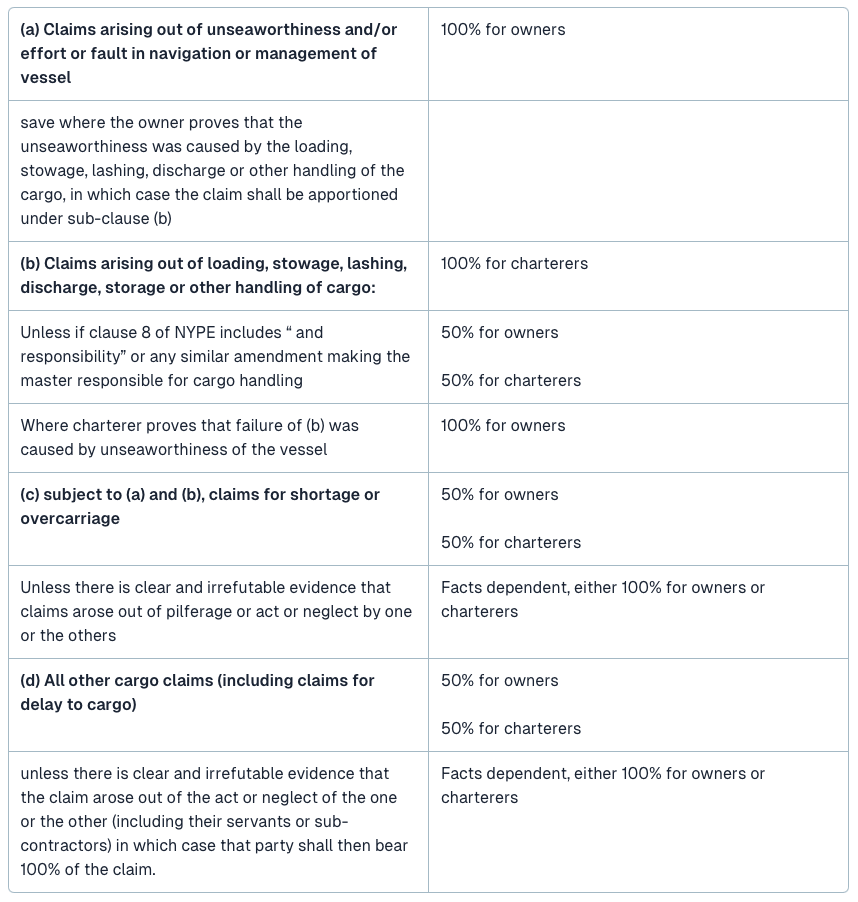
When the ICA is incorporated in a charterparty in the NYPE form, it constitutes a carve out for cargo claims. It provides a mechanism that aims at saving time and costs when disputes arise as between owners and charterers on who is ultimately responsible to pay a cargo claim.
For cargo claims arising out of cargo operations, such apportionment is set out in clause 8b of the ICA. Cargo claims are entirely for charterers’ account where they arise from cargo handling operations, unless either
responsibility for the entirety of the cargo handling operations has been transferred to the master in which case the cargo claim is shared equally; or
the problem with the cargo handling operation resulted from the unseaworthiness of the ship in which case the cargo claim is entirely for owners’ account.
The ICA 1996 expanded its scope to “all other claims whatsoever” with clause 8d, thus promoting its application to all types of cargo claims that do not fall within specific categories. Therefore “other claims” that would not clearly fall within 8b of the ICA (or the other categories), would fall within 8d of the ICA and would be shared equally between the parties unless there is clear and irrefutable evidence that the claim was caused by the act or neglect of one party or the other in which case that party bears the full loss. More information can be found in this Gard article.
Key Take Aways
What makes a good charterparty is clarity and certainty. When the responsibility for cargo operations is left vague, it creates a dangerous "operational gap." This often leads to a scenario where the master assumes the crew should not interfere, while the charterer—who does not have control of stevedores and is often geographically and operationally far away from them—expects the ship’s command to take the lead. This confusion can compromise the safety of the vessel and owners and charterers awareness should be raised in this respect.
The allocation of liability for cargo operations—particularly stowage, lashing, and securing—under Clause 8 of the NYPE forms remains a nuanced and evolving area of maritime law. While Clause 8 clearly assigns operational responsibility and expense to the charterers, English case law, especially Court Line v. Canadian Transport, confirms that this responsibility extends to the risk of improper performance, even when operations are conducted “under the supervision of the master.”
The master’s duty to maintain seaworthiness introduces a residual responsibility for owners, particularly when poor stowage compromises the vessel’s stability or when the master actively intervenes in cargo operations. The phrase “under the supervision of the master” grants a right—not a duty—to oversee operations and does not absolve charterers unless they can prove the damage resulted solely from the master’s direct orders.
Any intervention by the owners in the performance of cargo operations could give charterers scope to argue that such intervention constituted the effective cause of the damage, thereby breaking the chain of causation and relieving the charterers of liability.
The Interclub Agreement (ICA) provides certainty and clarity on how liability is apportioned between the parties. Adding just two words – "and responsibility” – to Clause 8 fundamentally changes the deal, shifting the liability split from 100% on the charterer to a 50/50 share with owners.
By understanding the legal implications of Clause 8 of the NYPE forms or of similar charterparty provisions, shipowners and charterers can better manage and allocate risks, safeguard the vessel’s and the cargo’s integrity, and minimize disputes.
Related Articles


Gard is a member of