Gard once again alerts Members and clients to the significant risks associated with bulk cargo liquefaction. The recent tragic loss of life of crew on a bulk carrier in the Bay of Bengal has renewed concerns regarding the safety of some iron ore fines shipments, particularly from ports on the east coast of India.

Published 02 September 2026
While the cause of the capsize and sinking has not yet been established, authorities have reported that the vessel was carrying iron ore fines from Paradip. Gard is also aware of further cases involving iron ore fines loaded in the region where liquefaction is suspected, and separately, a recent case involving the liquefaction of iron ore fines loaded in Brazil.
Group A cargoes: A perennial problem of liquefaction risk
Liquefaction of mineral cargoes, leading to cargo shift and loss of vessel stability, has been a recurring cause of bulk carrier casualties for decades. As highlighted in Intercargo's Bulk Carrier Casualty Report 2015-2024, the consequences can be catastrophic, resulting in loss of life, loss of vessels, and significant environmental and commercial impacts. Despite extensive international regulation and industry guidance, Gard continues to encounter cases where cargo is loaded in a dangerously wet condition, often linked to inadequate moisture management practices and concerns regarding the reliability of cargo sampling and testing arrangements on which shipper declarations are based.
Overview of Group A shipments from India
Gard's correspondent, James MacKintosh & Co., has prepared an overview of major Group A cargoes exported from India, including key loading regions and seasonal weather patterns.
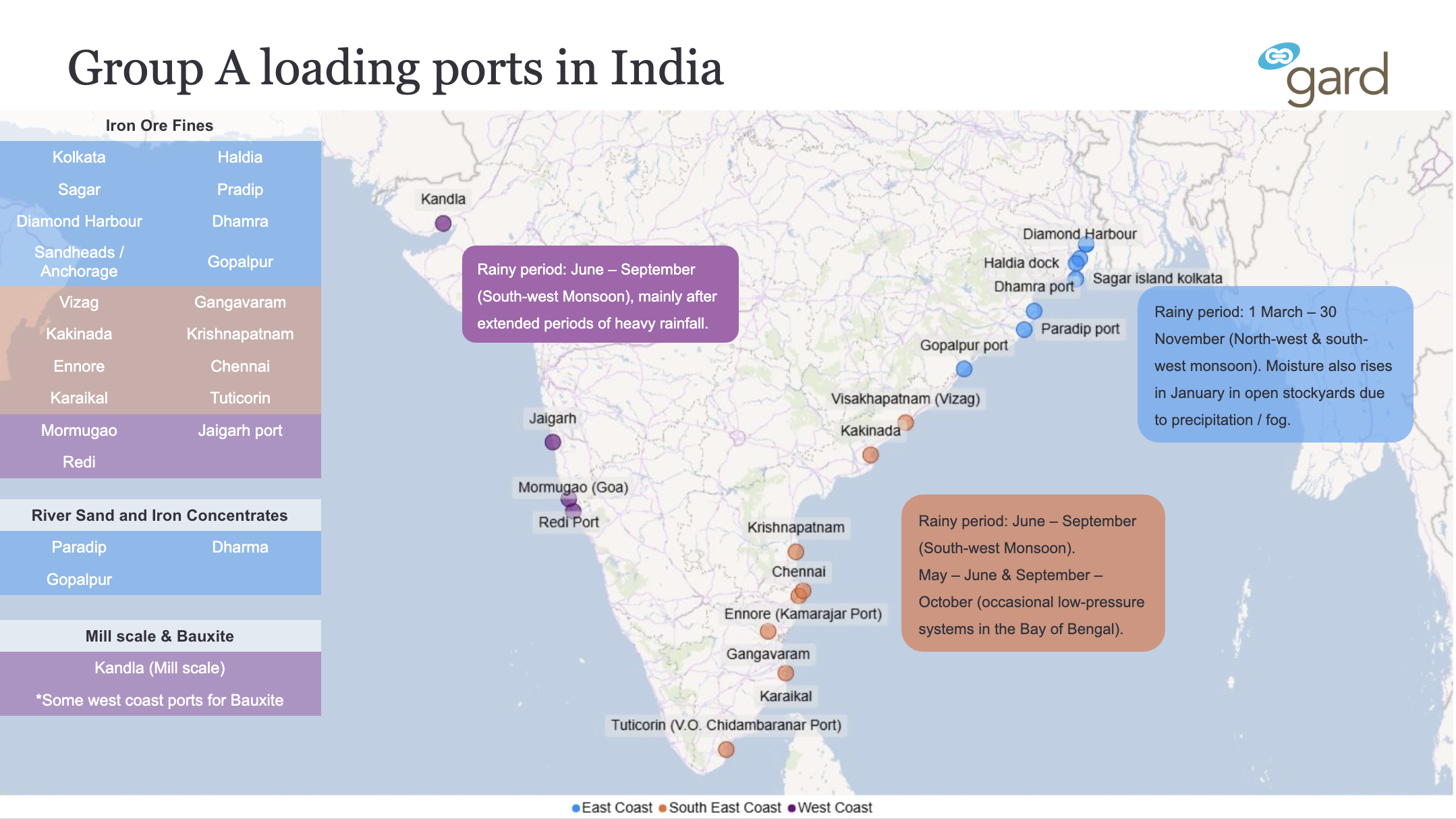
In many ports, stockpiles are stored in open yards, sometimes with only limited protection from tarpaulins, and may remain exposed to the elements during transportation by road, rail, or barge. These conditions can increase moisture content beyond the Transportable Moisture Limit (TML). The correspondent has also highlighted concerns that, where cargo is delivered to ships by barges, samples taken from shore stockpiles may not always be representative of the cargo ultimately loaded on board.
Regulatory requirements and local precautions
Our understanding is that NT/ENG Circular No. 2 of 2017 remains in force and should be read together with other notices (M.S. Notice No. 9 of 2010, M.S. Notice No. 31 of 2009, and M.S. Notice No. 34 of 2009). In addition, the Mercantile Marine Department (MMD) Kolkata has reportedly introduced further precautions for the carriage of Group A cargoes, although these have yet to be formally published through a circular.
This may affect the validity of the shipper's moisture content certificate. In particular, the certificate may become invalid following rainfall affecting the stockpile or cargo, requiring the shipper to carry out re-testing before loading can continue.
Gard also understands that references to TML testing onboard should not be interpreted as requiring owners to undertake laboratory testing of cargo samples. However, masters may be expected to conduct can-tests. It should be emphasized that can-tests are only a very basic screening tool and are not foolproof. They are not a substitute for independent laboratory testing, and cannot provide a confirmation of cargo being safe.
Members should also note that the Merchant Shipping (Carriage of Cargoes and Oil Fuels) Rules 2026, published in India on 2 September 2026, set out requirements for the approval of marine laboratories conducting testing under the IMSBC Code. The Rules also reaffirm that the shipper must provide the master with cargo information sufficiently in advance of loading in accordance with Section 1.3 of the IMSBC Code.
Members are encouraged to contact their local agents for the latest requirements and guidance applicable to specific loading ports. It is worth noting that some Indian ports may have issued local circulars and requirements that differ from guidance issued by the Directorate General of Shipping (India). Guidance can also be obtained from the local correspondent. In consultation with the Club, Members should consider appointing their own surveyor to assist the master.
Gard’s geofencing
Gard’s geofencing alerts are limited to owned vessels entered with Gard, and do not detect vessels for charterer Members. It is therefore important for charterers to notify Gard every time they fix their vessels for loading such cargo. The main purpose of the geofencing alert is not to monitor our Member’s activity, but to provide support by highlighting the risks involved when carrying cargoes that can liquefy and the precautions that can be taken to mitigate those risks. For further information, please refer to the Gard article ‘Geofencing – targeted and timely loss prevention advice to Members’.
Key recommendations
Members with vessels scheduled to load iron ore fines or other Group A cargoes in India should exercise heightened caution and ensure that shippers fully comply with their obligations under the IMSBC Code. Particular attention should be paid to cargo declarations and certificates for moisture content and the transportable moisture limit, and to evidence that approved moisture management, sampling, and testing procedures are being followed and are code compliant.
The IMSBC Code states that bilges should be sounded and that the appearance of the surface of the cargo shall be checked regularly during the voyage. Risk indicators include cargo shift or movement of the stow with the vessel, a flattening of the cargo profile, softening at the periphery or surface water and slurry. If there are concerns that liquefaction may be occurring, the master should seek third party expert support and take action to reduce the energy input into the cargo (e.g., avoiding beam seas). Early intervention can be critical in preventing a deterioration of the vessel's stability condition.
Members should consider how they might protect themselves contractually before agreeing to carry Group A cargoes - for example, by including the BIMCO Solid Bulk Cargoes that Can Liquefy Clause for Charter Parties 2012.
Related Articles


Gard is a member of