Safe pilot transfer operations depend on both correct procedures and fit-for-purpose equipment. New SOLAS requirements entering into force in 2028 will introduce mandatory performance standards for pilot transfer arrangements, and some existing installations may require physical modifications. Ship operators should start a fleet-wide review of their arrangements now.
Written by

Published 23 October 2026
Pilot ladders remain a recurring safety concern
Successive safety campaigns by the International Maritime Pilots' Association (IMPA) provide a useful picture of the scale and nature of non-compliant pilot transfer arrangements. The 2026 campaign recorded 4,051 observations from pilots across 34 countries, with an overall non-compliance rate of 13%. While this represents a slight improvement from the previous year, IMPA reports no significant change to historic non-compliance trends.
More than half of the non-compliances concerned the pilot ladder itself, with access to the deck, safety equipment and combination arrangements also recurring areas of concern. Common defects included incorrectly rigged retrieval lines, ladders not secured to strong points and missing lifebuoys.
Port State control findings tell a similar story. In its August 2025 safety bulletin, the Tokyo MOU reported that deficiencies related to pilot transfer arrangements increased from 197 in 2020 to 523 in 2024, with associated detentions rising from one to 12. Recurring issues included failure to properly secure pilot and accommodation ladders to the ship's side, inadequate securing of stanchions with locking pins, complacency regarding ladder maintenance, and a lack of clear identification and differentiation between pilot ladders and other types of ladders.
When things go wrong
Accidents associated with pilot transfer arrangements have resulted in fatalities and serious injuries, and the risks are not limited to the pilots using them. Crew members responsible for preparing and rigging the arrangements can also be exposed to serious hazards. The UK's Marine Accident Investigation Branch (MAIB) has investigated many incidents involving falls and injuries associated with pilot transfer operations.
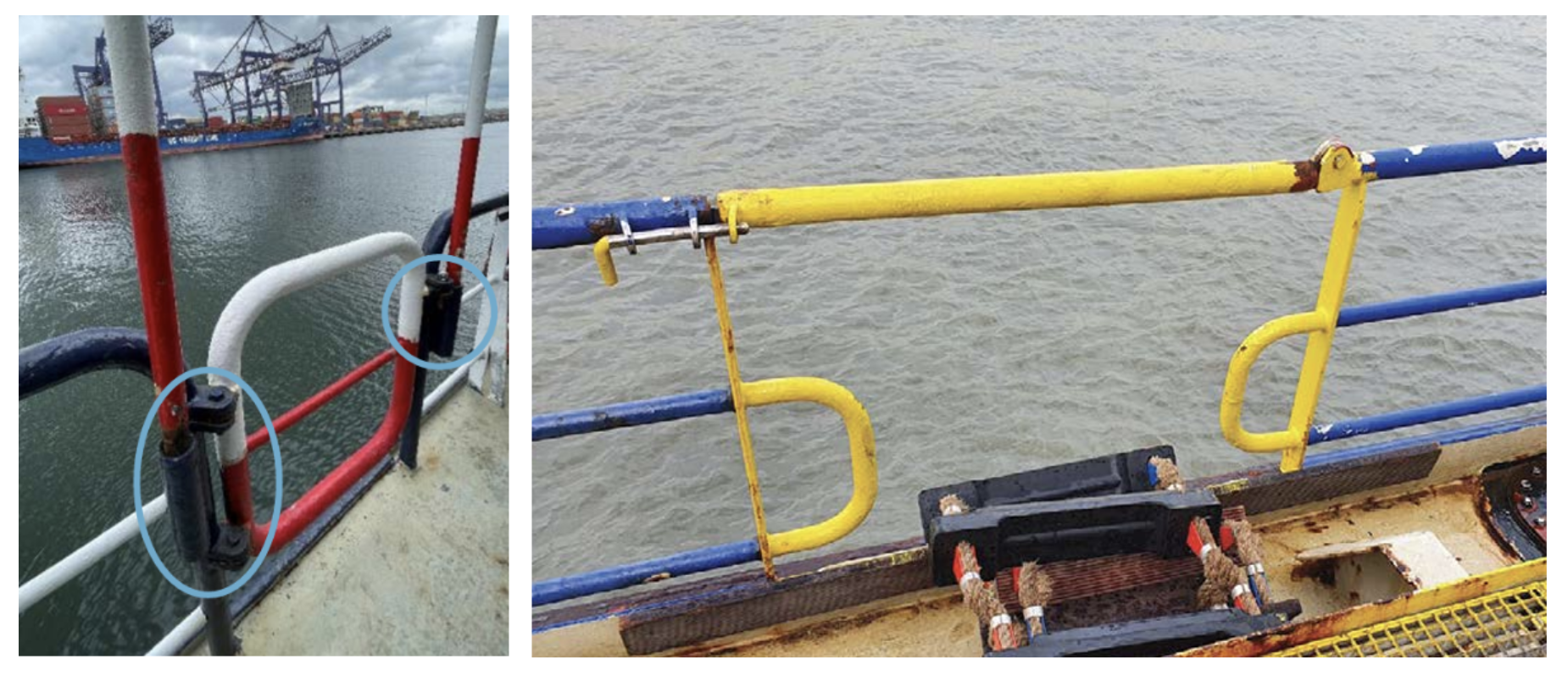
In one such case, a pilot fell approximately three metres onto a pilot boat and suffered a fractured ankle after losing their grip on a handhold stanchion. MAIB's preliminary assessment found that the stanchions were not fit for purpose, as their design prevented the pilot from gaining a firm grip when reaching the top of the ladder.
The examples below, taken from the MAIB Annual Report 2022, show non-compliant handhold stanchions at the transition from the pilot ladder to the deck.
More recently, in October 2025, the bosun of a bulk carrier died after falling overboard while the crew was preparing the pilot ladder. The MAIB investigation found that the pilot ladder davit was not fit for use and that the crew had become accustomed to manually lowering and recovering the ladder close to an unguarded deck edge. This unsafe practice had become normalised, placing the crew at serious risk. Crew members working in the area were also not equipped with appropriate personal protective equipment to prevent a fall, arrest a fall or support them in the water.
New requirements from 2028
In June 2025, IMO adopted revised SOLAS Regulation V/23 and new mandatory Performance Standards for Pilot Transfer Arrangements (MSC.572(110) and MSC.576(110)), entering into force on 1 January 2028. The standards address the design, installation, maintenance and safe use of pilot transfer arrangements and also apply to existing arrangements. The important timeline is as follows:
New installations: Pilot transfer arrangements installed on or after 1 January 2028 must meet the new requirements for design, manufacture, construction, securing, and installation (Parts A, B and C of MSC.576(110)).
Existing installations: Arrangements installed before 1 January 2028 must meet the same requirements by the first survey on or after 1 January 2029 for SOLAS ships and 1 January 2030 for non-SOLAS ships.
All installations: Requirements for inspection, stowage, maintenance, replacement, and familiarisation apply from 1 January 2028, regardless of installation date (Introduction and Parts D and E of MSC.576(110)).
Compliance may require physical modifications to existing pilot transfer arrangements. Examples include more detailed provisions for the strength, marking and documentation of strong points used for securing ladders and manropes. More specific provisions also apply to access to deck, including the dimensions, positioning and securing of handholds and stanchions. Combination arrangements using an accommodation ladder are also subject to more detailed requirements, including for trapdoor openings, the positioning of the pilot ladder and the provision of handholds. Older accommodation ladder arrangements, particularly those dating from before the 2012 SOLAS amendments, may require more extensive modifications.
For further details on the changes and their implementation, see the technical bulletins available on the websites of classification societies, including DNV, Lloyd’s Register, ABS, and ClassNK.
For practical guidance, IMO circular MSC.1/Circ.1428/Rev.1 provides updated illustrations of pilot transfer arrangements compliant with the new performance standards. The illustrations are also available to download via the IMPA resource page.
What should ship operators do now?
Ship operators should start preparing early. Key actions include:
Assessing existing pilot transfer arrangements against the new requirements to identify any compliance gaps.
Planning necessary modifications, particularly where engineering work or structural alterations may be required, and considering whether these can be coordinated with already scheduled repairs or drydock periods.
Reviewing the ship's safety management system (SMS) and planned maintenance system (PMS) to ensure that pilot transfer procedures, training and maintenance are appropriately addressed.
Engaging with the ship's classification society and flag Administration early, particularly where modifications may require approval.
Safe pilot transfer also depends on how the operation is carried out in practice. Risks should be properly assessed and controlled for each transfer, both during the transfer itself and when the arrangement is prepared, rigged and recovered. Clear communication between the vessel and pilot should ensure that the required arrangement, including the ladder position and height above the water, is understood before the transfer. Appropriate PPE, effective supervision, and proper training and familiarisation of those involved remain essential.
Related Articles


Gard is a member of