Claims involving excessive sulphur content in marine fuels have seen an upward trend recently. At the same time, we are seeing a heightened focus on sulphur compliance driven by stricter inspections by the China MSA, with a distinct concentration of enforcement activity in the Bohai Sea.
Written by

Christina Kwok
Deputy Underwriter

Bruce Liu
Loss Prevention Executive
Published 12 August 2026
Rise in off-spec sulphur claims
Recent claims experience indicates that bunker quality continues to pose a significant operational risk for shipowners. In our earlier review of bunker-related claims during the first five months of 2026, we highlighted a rise in off-specification bunker incidents amid increased pressure on global fuel supply chains following the escalation of the conflict in the Middle East.
Specifically for Sulphur compliance, between January and June 2026, the number of sulphur-related cases increased by more than threefold compared with the same period in 2025. Notably, the number of cases recorded in the first six months of this year has already exceeded the total number reported during the whole of last year by approximately 40%.
While each case is fact-specific, the increase is notable because excessive sulphur content constitutes a MARPOL compliance issue. Unlike many other bunker quality problems, sulphur non-compliance identified through port state inspections can result in vessel delays, enforcement action, and substantial costs associated with debunkering and fuel disposal.
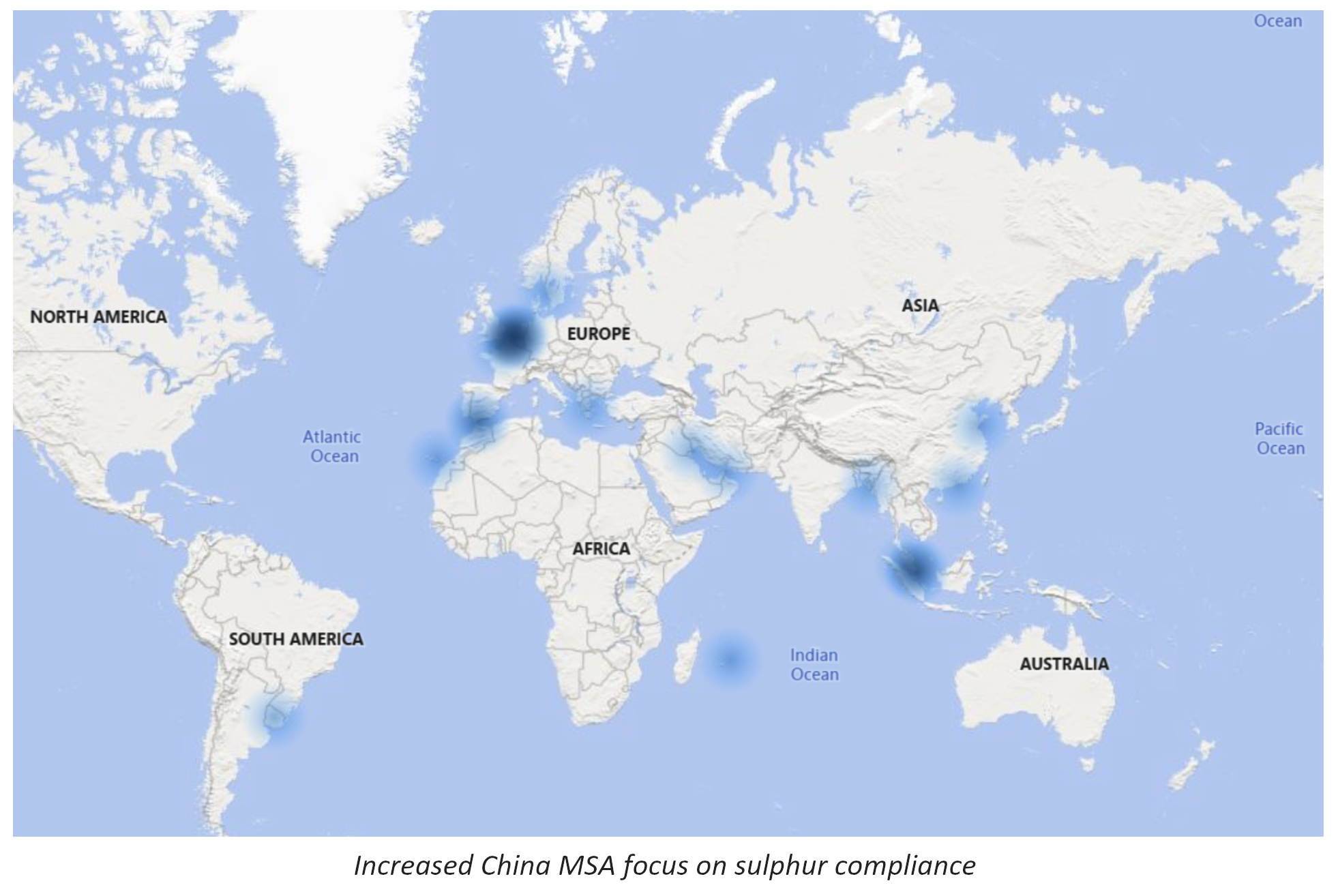
The map below illustrates the geographical distribution of sulphur-related claims recorded during the first six months of 2026, based on the location where the bunkers were stemmed.
China MSA steps up sulphur compliance enforcement
According to our correspondent, Huatai, on 5 June 2026, the maritime authorities of Tianjin, Hebei, Liaoning and Shandong jointly launched a special campaign on ship pollution prevention and control in the Bohai Sea region. The campaign involves coordinated supervision by local MSA branches across the region and is expected to last nearly five months. It covers major ports and surrounding port areas in the Bohai Sea region, including Tianjin, Tangshan, Qinhuangdao, Huanghua, Jinzhou, Yingkou and Longkou.
While the initiative is broader than bunker sulphur compliance alone, its scope includes inspections relating to air pollution prevention, SOx emissions, fuel compliance and other high-pollution-risk operations. Enforcement measures are expected to comprise onboard inspections, cross-regional enforcement activities, unannounced spot checks and remote monitoring. These efforts will be supported by a combination of UAV patrols, maritime patrol vessels, shore-based monitoring systems and rapid on-site fuel testing.
As a result, vessels trading in the Bohai Sea region may experience increased scrutiny of fuel compliance documentation, fuel sampling records, onboard fuel management procedures, and the handling or disposal of suspected non-compliant fuel.
Case Study: Sulphur non-compliance identified by China MSA
A recent case involved a vessel calling at Panjin, China. While the vessel was alongside, China MSA officers carried out an onboard inspection and collected in-use fuel oil samples from the boiler fuel system. Preliminary analysis using a portable MSA testing device indicated a sulphur content between 2.5% and 2.7%. A parallel sample taken directly from the service tank produced similar results.
During the inspection, three sample bottles were drawn. Two samples were retained by the MSA for laboratory analysis, while the third was left onboard for the vessel's records.
Pending the outcome of the investigation, the Master was instructed to immediately cease consumption of the suspected fuel. Subsequent laboratory testing by the MSA confirmed a sulphur content of 2.51%, significantly exceeding the applicable regulatory limit. The authorities further required the vessel to stop using the non-compliant fuel and submit a disposal plan endorsed by the Master. At the time of writing, the final administrative penalty had not yet been determined and remains subject to the authorities' assessment.
Documents typically requested by China MSA
Based on our recent experience, including the case discussed above, and subject to the specific requirements of the local MSA office, owners and operators may be requested to provide supporting documentation such as:
Bunker documentation – Bunker Delivery Notes (BDNs), MARPOL fuel sample records, fuel test reports, and relevant fuel quality certificates.
Statutory certificates – including the International Air Pollution Prevention (IAPP) Certificate and International Oil Pollution Prevention (IOPP) Certificate.
Operational records – engine logbooks, deck and navigation logbooks, Oil Record Book entries, and records relating to fuel transfers, storage and consumption.
Sampling documentation – the Master's statement and any records demonstrating how fuel samples were drawn, sealed, labelled, handled and retained.
Correspondence records – communications with the authorities, bunker suppliers, charterers and other relevant stakeholders.
Fuel disposal records – approved disposal plans, debunkering documentation, receipts and evidence of final disposal, where applicable.
The exact documentation required will depend on the nature of the investigation, the findings of the inspection, and the requirements of the local enforcement authority.
Possible regulatory consequences in China
Under the Air Pollution Prevention and Control Law of the People's Republic of China, ocean-going vessels are required to use fuel oil meeting atmospheric pollutant control requirements after berthing. Vessels operating within designated emission control areas must also comply with applicable emission standards. Article 106 provides that where vessel fuel oil fails to meet applicable standards or requirements, the competent maritime authorities may impose fines ranging from RMB 10,000 to RMB 100,000. Liability may extend to shipowners, ship operators and ship managers depending upon the circumstances of the case.
Recommendation
Sulphur compliance should be treated as both a fuel quality and regulatory risk. Owners and operators are encouraged to take preventive steps before bunkering, act promptly if non-compliant fuel is suspected, and preserve evidence carefully if an inspection or claim arises. Under amended Resolution A.1206(34), Appendix 18, 2.1.5, if the BDN shows compliant fuel, but the master has independent test results of the fuel oil sample taken by the ship during the bunkering which indicates non-compliance, the master may document this by notifying the ship's flag Administration, with copies to:
the competent authority of the relevant port of destination,
the Administration under whose jurisdiction the bunker deliverer is located,
and to the bunker deliverer.
Reference
Related Articles


Gard is a member of