A new emission control area (ECA) in the North-East Atlantic Ocean has been formally adopted by the IMO, tightening air emission requirements across a large part of European waters and linking existing ECAs in Europe to the Canadian Arctic ECA.
Published 09 June 2026
At its 84th session (MEPC 84) on 1 May 2026, the IMO Marine Environment Protection Committee adopted amendments to MARPOL Annex VI Regulations 13 and 14, designating the North‑East Atlantic Ocean as an Emission Control Area (ECA) for nitrogen oxides (NOx), sulphur oxides (SOx) and particulate matter (PM). The amendments were adopted through Resolution MEPC.407(84).
Geographical extent
The new ECA will encompass the territorial seas and exclusive economic zones (EEZs) of Greenland, Iceland, the Faroe Islands, and the western coasts of the United Kingdom and Ireland, extending south to Spain and Portugal, and effectively linking the existing Mediterranean, Baltic, North Sea and Norwegian Sea ECAs with the Canadian Arctic ECA.
The map below is for illustrative purposes only.
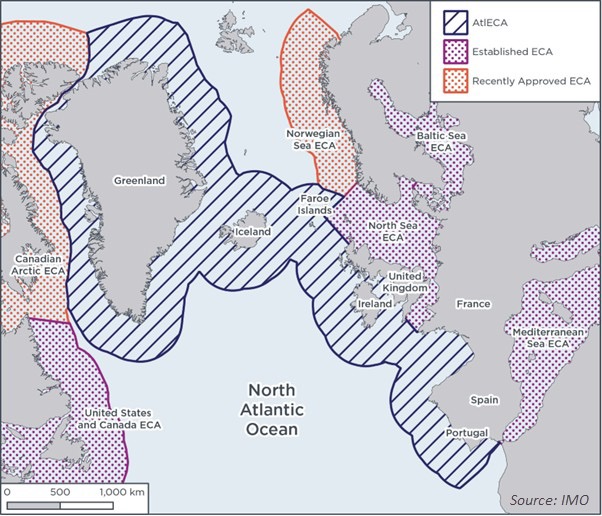
The Clean Arctic Alliance has issued a series of infographics, including a useful overview of existing and upcoming ECAs designated under MARPOL Annex VI.
Implementation timeline
The amendments to MARPOL Annex VI will formally enter into force 16 months after adoption, i.e. on 1 September 2027. In practical terms, however, different timelines apply for NOx and SOx requirements.
For NOx Tier III, the engine certification requirements will apply to ships constructed on or after 1 January 2027 and operating within the ECA, i.e. ships with a building contract placed on or after 1 January 2027, or, in the absence of such a contract, with keel laying on or after 1 July 2027, or delivery on or after 1 January 2031.
For SOx, ships operating within the ECA will be required to use fuel oil with a sulphur content not exceeding 0.10 per cent m/m from 1 September 2028, i.e. 12 months after the ECA’s entry into force. Equivalent compliance methods may also be used, including approved exhaust gas cleaning systems or alternative fuels that achieve an equivalent reduction in sulphur emissions.
Operational considerations
Ship operators should take note of the above and ensure that bunkering procurement and onboard procedures remain compliant with MARPOL requirements in force at any given time. With most European and North American waters now designated as ECAs, particular attention should be given to the availability of compliant fuels and to ensuring that fuel changeover procedures are in place and correctly implemented before entering an ECA.
Crew awareness is equally important. Personnel should be familiar with ECA boundaries, entry points and associated procedures to minimise the risk of operational issues and inadvertent non‑compliance.
Fine particulate matter (PM) presents a particular health risk due to its ability to penetrate deep into the lungs and enter the bloodstream. As reducing sulphur content in fuel also lowers PM emissions, many regions, states and ports have introduced their own strict sulphur limits. A round‑up of selected requirements is available in our article “Regional sulphur emission limits at a glance”.
Ship operators should therefore ensure that crews are familiar with sulphur emission limits not only in MARPOL-designated ECAs, but across all jurisdictions in which the vessel trades. Clear onboard procedures and guidance should support this. As local requirements may change at short notice and enforcement practices can vary, masters should seek advice from agents well in advance of each port call.
Related Articles


Gard is a member of