Global piracy rose in 2025, with regional patterns varying and some areas showing improvements. Most incidents were low severity and fewer crew suffered physical harm, yet the aggressive behaviour of perpetrators can still have serious psychological impacts on seafarers.
Published 28 January 2026
Positive and negative trends in global piracy
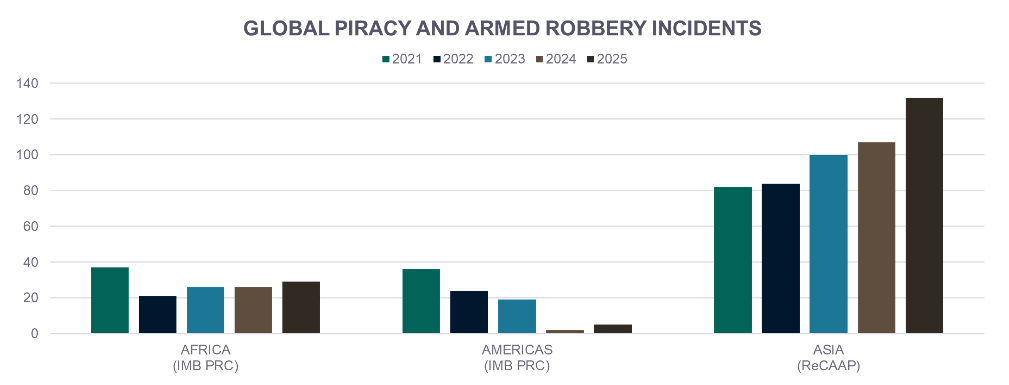
Global piracy and armed robbery incidents increased by 23% in 2025 compared to 2024, according to the International Maritime Bureau’s Piracy Reporting Centre (IMB PRC). While this overall increase is concerning, a closer look at the figures reveals encouraging trends and improvements in specific regions and operational areas:
Incidents in Gulf of Guinea waters remained at historically low levels also in 2025. However, crew safety continues to be a concern, as the number of kidnapped crew increased from 12 in 2024 to 23 in 2025, and the region accounted for 92% of all crew kidnappings worldwide during the year.
Reports of renewed Somali pirate activity sparked significant concern in 2023-24, and another five incidents were recorded off the Somali coast in 2025. This included the hijacking of two fishing vessels and a dhow, with a total of 26 crew members taken hostage. Two incidents occurred at considerable distances from the Somali coastline, demonstrating the Somali pirates continued operational reach and capability.
With five incidents recorded in the Americas in 2025, the region experienced a second consecutive year of relatively low activity. However, an incident off Haiti resulted in the abduction of two crew members from a drifting bulk carrier, the first recorded kidnapping in the region in the past decade.
Armed robbery in Southeast Asian waters, particularly in the Singapore Strait, continued in 2025. According to the Regional Cooperation Agreement on Combating Piracy and Armed Robbery against Ships in Asia Information Sharing Centre (ReCAAP ISC), 2025 saw the highest number of incidents in the Strait since 2007. Arrests of suspected armed robbers in July and August 2024 helped reduce incidents in the second half of 2025. However, four incidents recorded in the Singapore Strait between 1–27 January 2026 serves as reminder that the threat remains.
Impact on crew
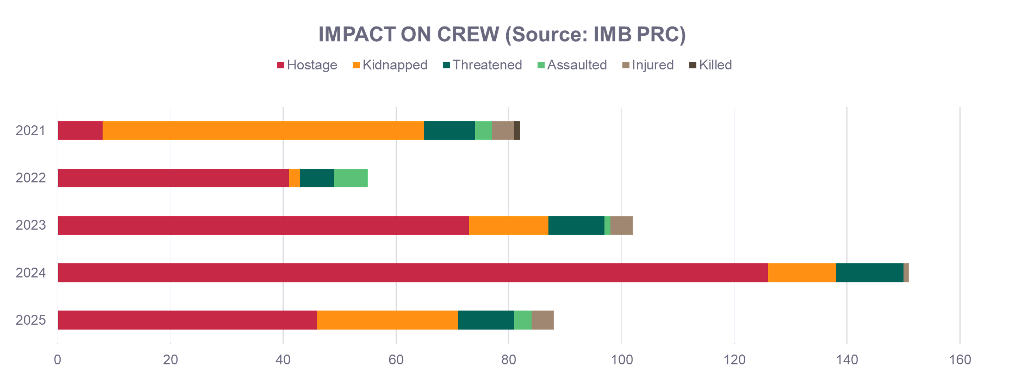
On a positive note, the IMB PRC reported a substantial year-on-year decrease in the in the number of crew impacted by piracy incidents globally, with 88 directly impacted in 2025 versus 151 in 2024. This decline can partly be attributed to fewer hostages taken in incidents off the Somali coast and also reflects a reduction in the severity of incidents in Southeast Asian waters, as confirmed by ReCAAP ISC’s 2025 figures.
However, the continued use of weapons and threats against crews remains a worrying trend. The IMB PRC reported that 46 crew members were taken hostage, 25 kidnapped, 10 threatened, four injured and three assaulted. The agency also noted a rise in the use of guns, reported in 30% of all incidents in 2025 compared with 22% in 2024. Knives and other weapons were also commonly observed, as confirmed by ReCAAP ISC. Although these weapons were often not used to harm crew directly, but rather to cut mooring ropes, remove secured items, restrict crew movement, or compel the surrender of personal belongings, piracy incidents can nevertheless have a deep and lasting psychological impact on those who experience them.
Regional trends: a closer look
AFRICA
According to the IMB PRC, 29 incidents were recorded in African waters in 2025, up from 26 in 2024. Despite the resurgence of Somali pirate activity, West African waters continue to account for the majority of incidents, representing 72% of all incidents reported from African waters.
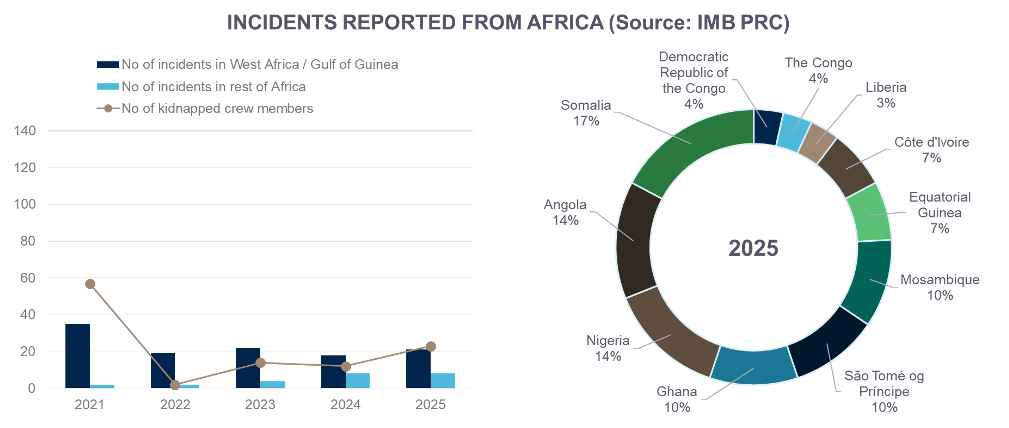
Since 2020, increased naval presence and cooperation between coastal authorities in the Gulf of Guinea have helped reduce piracy in the region, with incidents falling from 84 in 2020 and 35 in 2021 to around 20 per year over the following four years. However, despite this overall improvement, crew remain at risk in West African waters, as kidnappings have trended slightly upward over the same period, nearly doubling from 12 in 2024 to 23 in 2025.
As in 2024, Angola tops the list of West African countries reporting piracy incidents in 2025, but is this year also joined by Nigeria. In 2025, 57% of the incidents in West African waters occurred while vessels were anchored or berthed.
The Indian Ocean High Risk Area (HRA) was removed in January 2023 after several years without any Somali pirate attacks. However, the IMB PRC has continually warned that Somali pirates retain the capability and capacity to carry out attacks in the Gulf of Aden/Indian Ocean region, urging masters to remain vigilant. While the Somali pirate activity in 2025 was lower than in 2024, the IMB PRC continue to advise masters and shipowners to register their vessels and report in accordance with the latest industry Best Management Practice (BMP) procedures, ensure vessels are properly hardened before entering these waters and maintain a 24-hour visual and radar watch.
THE AMERICAS
Five incidents were recorded in South and Central American and Caribbean waters in 2025, continuing a trend of relatively low activity in the region, though slightly higher than in 2024. Three of the five vessels were targeted while underway rather than at berth or anchor, a shift from the region’s usual pattern. In an incident off Haiti, two crew members were abducted from a bulk carrier, the first reported kidnapping in the region in the past decade.
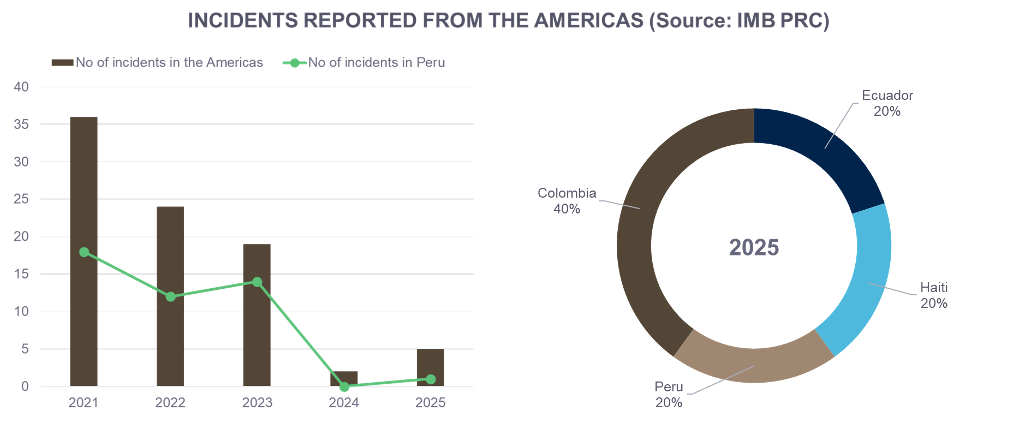
Even with the overall low level of incidents, the agency continues to warn masters and crews to remain vigilant when operating near known risk areas, including Haiti (port Au Prince), as well as past hot spots, such as Colombia (Cartagena), Peru (Callao), Ecuador (Guayaquil), Brazil (Macapa), Venezuela (Puerto La Cruz / Puerto Jose / Guanta), and Mexico (Puerto Dos Bocas).
ASIA
According to ReCAAP ISC, 132 incidents were recorded in Asian waters in 2025, up from 107 in 2024. Most incidents were classified as armed robbery/petty theft, with the Straits of Malacca and Singapore (SOMS) remaining Asia's primary area of concern. The agency also noted a slight year-on-year increase in reported incidents in India, while other former hot spots, including Indonesia, Bangladesh and the Philippines, recorded improvements in 2025.
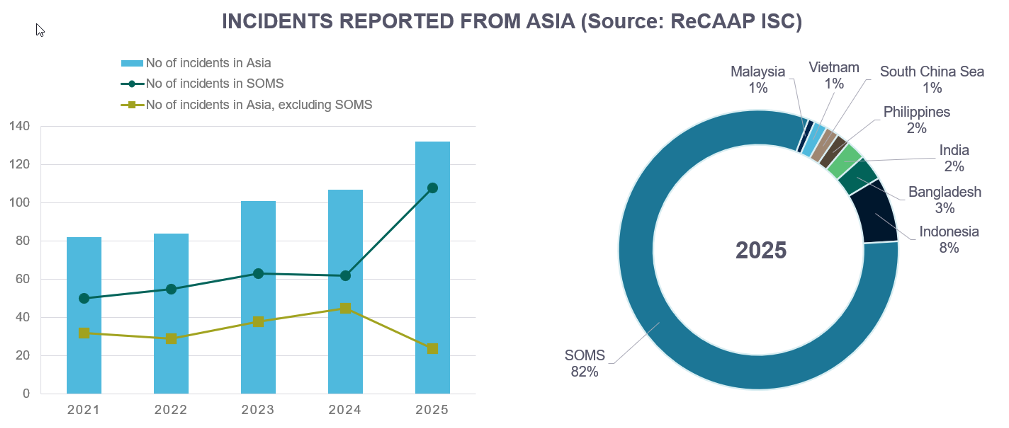
Incidents in the Singapore Strait continued to rise, with 107 cases reported in 2025 compared to 61 in 2024 and 58 in 2023. However, a significant decline was observed during the second half of 2025 following a series of arrests of perpetrators operating in the area by the Indonesian authorities. Most incidents occurred at night in the Straits’ eastbound lane, with bulk carriers being the most frequently targeted vessel type, followed by tankers and container vessels. While incidents were predominantly reported as low-level opportunistic thefts, with little physical injuries to crews, perpetrators were often armed with knives or other weapon-like objects used to threaten crew members. ReCAAP ISC continues to identify Strait waters off Pulau Cula, Indonesia in the Philip Channel as an area of particular concern and issued six incident alerts in 2025 advising masters and crews to intensify vigilance and maintain sharp lookout while transiting the area, especially during hours of darkness.
No abductions of crew for ransom have been reported from the Sulu-Celebes Seas and Eastern Sabah region since January 2020. In February 2025, the Philippine Coast Guard (PCG) furthered downgraded the threat level in the area from ‘MODERATE LOW’ to ‘LOW’, indicating that “no information or monitored activities suggest an impending attack. Nevertheless, ReCAAP ISC continues to advise masters and shipowners to exercise vigilance, report incidents to the Operation Centres of the Philippines and Eastern Sabah Security Command (ESSCOM) and maintain communication with the relevant authorities when transiting the area.
Stay alert!
The level of threat from piracy and armed robbery at sea, as well as the opportunity for and modus operandi of the perpetrators, differs between regions and may also change quickly.
Prior to entering any piracy prone area, it is important to:
Gather up-to-date information from local authorities and maritime security specialists.
Revisit the vessel’s security plan based on the latest intelligence.
Carry out a voyage-specific risk assessment.
Prepare the crew through briefings and drills
Test the vessel’s emergency communication systems.
Relevant preventive measures must be adopted, following available industry guidance and BMPs. The potential consequences of not following industry best practices may be severe when transiting areas prone to piracy.
As vessels may be particularly vulnerable when at anchor, masters and crew should exercise extra vigilance when staying at high-risk ports/anchorages. Remember that a proper lookout is considered one of the most effective methods of vessel protection. It can help identify a suspicious approach or attack at an early stage, allowing defences to be deployed.
Please refer to Gard’s website “Piracy and armed robbery at sea” for further advice.
Related Articles


Gard is a member of