Continuing our series on heavy weather risks, this article turns to the sea passage, when vessels may be more exposed to sustained or deteriorating conditions. We examine scenarios, decision points and operational pressures that can turn heavy weather into a potential casualty.
Written by

Mark Russell
Vice President, Global Claims Lead, Safer with Gard

Bruce Liu
Loss Prevention Executive
Published 05 March 2026
In our last Insight we considered heavy weather risks in and leaving port. In this Insight we focus on the sea passage, when the ship and those onboard can soon find themselves without shelter and with limited assistance.
Commence or delay the passage?
Before the ship leaves shelter for a sea passage, it is prudent to assess whether departure should be delayed. It can allow heavy weather to pass through or more time to complete additional cargo and ship securing. The master may feel under commercial pressure to sail despite a deteriorating forecast or an under-prepared ship. Even without such pressure, there can be danger in leaving a decision to sail solely with the master. That was the indication from this investigation into a cargo shift that punctured tanks and flooded the hold, causing the vessel to list up to 45 degrees. Several crew members were injured and all were evacuated before the vessel was finally salved.
Securing for departure
It is normal to secure the vessel for potential heavy weather on passage, including anchors, openings and loose gear, especially on deck. The danger of leaving this work until after the vessel has left shelter is made clear further below. The forecastle needs particular attention as it will face the brunt of slamming forces and wave impact with potential for water ingress. Anchor securing also needs double checking. There are several known occurrences of an anchor becoming dislodged from its housing in heavy weather, with the vessel continuing underway not realizing that the paid-out anchor drags along the seabed damaging sub-sea infrastructure. In one case involving sub-sea cable damage, the crew assumed the increased engine load was a machinery issue in heavy weather. It was estimated the anchor had been deployed for approximately 31 hours before the crew discovered it.
Passage planning and weather routeing
Weather has always been a key consideration in passage planning and today high-capacity broadband makes it possible to provide connected ships with more real time information. Routeing costs, schedules, fuel efficiency, and emissions, even harnessing wind for propulsion, make routeing decisions today more operationally important than ever before. This has led to many more ships receiving weather routeing services from specialist companies ashore. Adjustments to passage plans are now made with increased frequency in the pursuit of optimization. Whoever stands to benefit most, increasingly complex commercial considerations are influencing decision making onboard.
Even though SOLAS makes clear that masters shall not be constrained from taking decisions necessary to maintain the safety of the ship, support from their own company ashore remains important. This is particularly the case where a master may sense some commercial pressure to maintain a schedule or from a charterer who stands to benefit from route optimization. Relevant charterparty clauses recognize the discretion of a master to deviate from a charterer’s preferred route. The sophistication of weather routing services may nevertheless encourage greater reliance on assessments made by specialists ashore. These assessments may suffer some shortcomings and the company ashore can assist a master with objective review. In a recent arbitration, the owners lost a dispute with charterers over hire and bunkers when a master decided to turn the ship around to take a safer route. The tribunal found that it was reasonable for the master to reject the weather routeing company’s recommended route with forecast wave heights over 9 meters. However, they also found that the master should have critically evaluated the recommended route prior to sailing and his delay amounted to a breach of a legal duty to proceed with due dispatch.
This brings us back to the importance of passage planning. Early identification of weather systems of concern that may affect the route allows them to be checked at regular intervals for the latest information. Courses and speeds can then be adjusted to manage the risks. Even if heavy weather cannot be avoided, there may be a need to increase the safety margin provided for in the original plan or ECDIS generated route. If for example, the vessel can be expected to spend considerable time adjacent to a rocky coastline to leeward with no shelter, it may be prudent to increase the passing distance. As the incidents in this series of articles show, if something does go wrong, the time to react can become very precious. Owners can consider including heavy weather routeing reviews in navigational audits. Routeing service providers should be part of the conversation if they may also benefit from insights or lessons learnt from accidents and near misses.
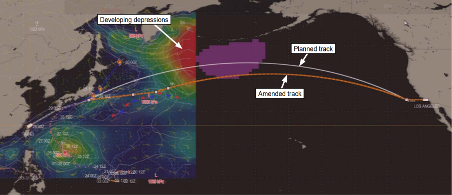
Weather routeing showing developing depressions with original and amended tracks
In the path of a storm
When the ship finds itself in the path of an unavoidable storm, decision making can become even more critical, especially if not made early and decisively to avoid the more dangerous side and to increase the passing distance. Regional meteorological bodies provide useful guidance in addition to that found in nautical publications. Riding out a storm will put extra stress on the ship’s hull and strain on the machinery. It may be necessary to heave-to at a low speed sufficient to maintain steerage for a heading that best minimizes pitching and rolling and, if closer to a lee shore, reduces the rate of drift. The drift should be closely monitored, and some Class societies include this in emergency response services. Emergency use of the anchors may ultimately become necessary if the water depth makes it feasible and the holding ground is suitable. There was a successful outcome for this vessel, which found itself beset by 58-mph winds and 29-foot seas on a rocky lee shore. The ship was commended for early notification to the authorities, which allowed contingencies to be put into place.
Direct impacts for those onboard
For crew, working on deck in heavy weather continues to cause fatalities and serious injuries. The table below gives an overview of just some of the investigations conducted into crew fatalities and injuries from 2020-2023. There have been more since and Gard is handling a recent fatal accident involving a container ship crew attempting to clear entangled mooring lines on the forecastle. That is where most of the accidents in the table below occurred, though one also occurred on the poop deck.
Seas on deck causing crew to be crushed or swept overboard can happen suddenly and unexpectedly, and despite precautions. In the tabled cases high wave heights were prevailing or forecast and those that led to accidents were likely higher. Forecasts are usually based on the significant wave height and it is important to note that this is usually defined as the average height of the highest one-third of waves (sea and swell) experienced over time. One in every seven waves may be higher than the significant wave height and the maximum can be up to twice as high. Even higher rogue waves can occur and research into predicting them is ongoing. The investigation into the VLCC fatalities below concluded that a rogue wave was involved and the report provides valuable insights.
Vessel type | Consequence | Wave height (metres) | Work activity & location |
| Reefer | Four injuries, two being fatal | in excess of 3 | Securing mooring lines and equipment on forecastle |
| Capesize bulk carrier | One crew swept and lost overboard | 1.5-2.4, forecast 5-8 | Collecting tools after repairing fire line leak on main deck |
| Handy size bulk carrier | Five injuries, one being fatal | 5-6 | Re-cover spurling pipes after forecastle flooding |
| VLCC | Two fatalities | 5, forecast up to 7 | Checking anchor lashings on forecastle |
| Handy size bulk carrier | Two crew swept and lost overboard | 8 | Securing loose mooring ropes on poop deck |
| Handy size bulk carrier | One fatality | 6-8 | Returning from forecastle anchor party |
The Code of Safe Working Practices for Merchant Seafarers (COSWP) makes clear that no one should be on deck in adverse conditions unless it is absolutely necessary for the safety of the ship or life. Any task that must proceed requires the master’s authorisation and full risk assessment with a permit to work.
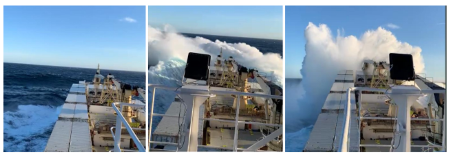
Seas on deck are not the only danger to crew during heavy weather. Fatalities have also occurred under-deck, as was the case in this investigation, when crew were assessing a cargo shift. In prolonged heavy weather, decision making onboard can be impaired by fatigue or anxiety. The company ashore has a role in encouraging open communication and “stop work” authority when assessing the hazards versus necessity of the work. Just because a heavy‑weather checklist refers to rigging of safety lines and adjusting the course and speed to mitigate conditions onboard, this does not mean that work should be undertaken.
Gard has also recently seen that serious injuries can occur during extreme rolling, especially if it causes inadequately secured items to break loose in internal spaces. Whilst more violent ship motions can be unpredictable, they can be more likely when making course alterations so those onboard may need to be forewarned. Fatigue coupled with heavier motions amplifies the risk of more typical slips, trips and falls, not only to crew but also passengers who may be safer in cabins or at an inboard location. The above-mentioned VLCC accident occurred off Cape Horn, which has a reputation for dangerous waves. This was also the scene for another fatal accident on a cruise ship and an example of how powerful waves can expose weaker parts of a vessel such as the windows. The investigation found that the wave was not abnormally large or outside what the ship was designed to withstand. However, it rose far higher up than the crew had reason to expect. Investigations have referenced similar incidents from the past and a more recent wave in the North Sea smashed bridge windows disabling the ship.
Propulsion failure
Losing the ability to maneuver the ship in heavy weather, even temporarily, can leave it exposed to violent rolling from beam seas or increased drift towards a lee shore. Further insight [MR1] into the cause and prevention of engine failure can be found here. Even well-functioning machinery and equipment are put under greater strain in heavy weather. Problems may be exacerbated by the loaded condition, as indicated by this investigation where a bulk carrier in ballast was overwhelmed by severe gale-force winds as it attempted to turn and run with the weather until the storm abated. The effect of the wind on the sail area prevented the turn from being completed and despite maintaining propulsion, the vessel was blown broadside over 7 miles until it suffered a collision.
If there is machinery failure, as was the case in another investigation, even the best efforts of the crew may not be enough. The vessel lost power four miles from an offshore rock, which it eventually struck. This was despite the best efforts of engineers to repair a cracked lubrication oil pipe, a repair that was extremely difficult, if not impossible in such adverse conditions. On the bridge the master deployed the anchor which helped to change the heading, but not the rate of drift due to the water depth.
Structural failure
The loss of a ship from structural failure is now extremely rare due to lessons from past casualties. Although often connected with heavy weather, when these losses have occurred they are more typically associated with a ship specific issue such as a design defect or poorly conditioned hull..Improvements in design modelling, ship building materials and standards, IMO and Class requirements as well as more rigorous maintenance and inspection, means that modern hulls are strong enough to cope with weather they can reasonably expect to encounter. For older vessels or those with extensively altered hulls, in trades causing higher stresses, effective condition monitoring becomes more important as heavy weather and fatigue can combine to overwhelm residual structural strength.
Cargo failure
Cargo failure is a common risk in heavy weather and mostly associated with ships carrying multiple cargo units, such as containers, vehicles and break-bulk. However, it can also affect bulk cargoes at risk of capsize from liquefaction under the stimulus of compaction and vibration. For Group A cargoes the IMSBC Code guides crew to check the appearance of the cargo regularly during the voyage. The incident featured at the beginning of this article also involved a near capsize when 60-ton pieces of cargo broke lashings inadequate for the forecast conditions. Heavy or large non-standard cargo units such as this pose extra risk, and the ship may need support from lashing specialists in the company ashore. Units on deck are usually exposed to higher forces and can endanger the crew when attending lashings during the passage. If units fall overboard, they present a risk to other ships and the environment.
As Gard observed in this Insight, the recent re-routing of vessels around South Africa led to several incidents of cargo failure in unforgiving seas. More detailed guidance on cargo unit lashing and regulatory requirements can be found here. Notably a Class approved Cargo Securing Manual (CSM) reflecting standards set by the Code of Safe Practice for Cargo Stowage and Securing (CSS Code). The Code’s general principles importantly link decisions to the most severe weather conditions which may be expected by experience for the intended voyage. It also contains guidance on avoiding excessive accelerations caused by heavy weather and which should be part of the CSM. For the passage, this may involve alterations of course and/or speed as well as timely ballasting or de-ballasting to improve behaviour of the ship. The stability condition is a very relevant factor as a higher metacentric height (GM) produces greater acceleration forces.
Gard’s studies specifically into container losses have shown that more units usually mean more risk, as does the duration of exposure to progressively worsening weather and the wave heights encountered. We have also highlighted that when routing around South Africa options to re-route for weather are more limited.Whilst losses of significance off South Africa in 2024 were not repeated in 2025, they continue to occur elsewhere and reporting is now mandatory. Factors causing container stack collapses are numerous as highlighted by this Insight. AMSA has more recently published a bulletin on issues arising from accident investigations which have provided valuable input to the Top Tier project aiming to reduce container losses.
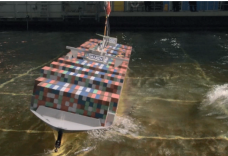
Wave model testing dangerous wave encounters
A fuller review of the Top Tier project is beyond the scope of this article, so comment here is limited to some reflections on where support to the crew is more relevant.
It can be difficult to predict conditions that can lead to resonant or parametric rolling and which have been found to cause most large-scale collapses. Crews benefit from digital tools that provide real-time risk warnings. More basic tools and a lack of experience can mean less attention to the risk of these dangerous conditions.
Lashing force calculations can differ between Class societies and a ship may use different lashing software from that used by a stow planner ashore. A lack of harmonised standards may result in stow planners using less prudent design limits. Masters facing schedule pressure may feel influenced to accept the shore plan even where the ship’s software shows excessive lashing forces.
In one accident investigation involving a 7000 TEU ship, the CSM listed over 13,000 twist locks and nearly 4,000 lashing rods and turnbuckles. On top of checking deck fittings for wear and tear, maintaining and inspecting such large volumes presents a significant challenge.
Key takeaways
We have seen in this article that decision making on passage can be safety critical. This can be impaired by fatigue from prolonged heavy weather and decisions can also be influenced by commercial factors. Technology increasingly aids decision making but it serves to remember Breton Fisherman’s Prayer, long since referenced in the opening pages to nautical publications for ocean passages. It reads:
“Oh God be good to me, Thy sea is so wide and my ship is so small”.
This respect for the sea, with support from the company ashore, can make all the difference.
In our next Insight we will look at heavy weather risks for ships at anchor, waiting off and entering port. Related reading from the same series:
Riding the storm: Managing heavy weather risks | Gard's Insights | Gard
Heavy weather risks in and leaving port | Gard's Insights | Gard
Related Articles


Gard is a member of