In the last of our series on heavy weather risks, this article turns to port arrival and entry scenarios, which remain a vulnerable phase of a voyage. If heavy weather strikes in this phase there are heightened risks to be managed.
Written by

Mark Russell
Vice President, Global Claims Lead, Safer with Gard

Jarle Fosen
Senior Loss Prevention Executive
Published 24 March 2026
In this heavy weather series we have previously considered factors relevant to keeping ships and crew out of harm’s way when they are in or leaving port and also when on passage. This last article examines risks when arriving at port. Whilst initiatives for “just in time” arrival continue to develop, there are many reasons why it is common for ships to arrive before they can proceed into port. Often the ship will anchor, but they may also wait off the port. Geopolitical events may lead to ships spending even longer times waiting off or at anchor, increasing the period during which vessels may be exposed to heavy weather.
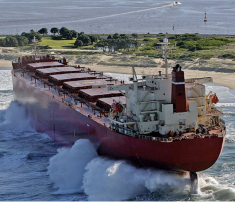
Vessel grounding after weighing anchor and attempting to put to sea in a storm
Anchoring trouble
Although anchoring is often treated as a routine task, many factors can combine to create situations where equipment is pushed beyond its intended design limits. Gard continues to see incidents involving anchor failure, despite earlier industry campaigns, and lost or dragging anchors are still a root causes of many groundings, collisions and contact damages, as outlined in this Insight. Class societies make it clear that even well-functioning equipment is only designed for temporary anchoring in a sheltered area, with no waves and good holding ground at normal depths. Outside shelter and allowing for wave loads, the wind limits are reduced significantly. It is important that masters are fully aware of these limits when heavy weather is forecast; also that the company ashore supports them, especially if commercial influences tempt more of a “wait and see” approach.
Investigators in one case indicated that a bulk carrier master may have felt influenced by the fact that the holds had been cleaned for loading, with notice of readiness served, so ballasting one of the holds would have led to delays and potential commercial implications. Being in light ballast condition with a larger windage area and propeller partially immersed, engines were used as the wind increased to try and reduce the strain on the anchor system. Despite ten shackles in relatively shallow water, the anchor chain broke and the vessel collided with another anchored vessel. This caused water ingress to the engine room and the vessel continued to drift contacting a windfarm under construction. Thereafter the crew were evacuated, and the vessel salved a few miles from the shore. The investigation analyzed the anchorage. It was unsheltered, with a sub-optimal holding ground, whilst the shallow depth likely increased the stretching effect of waves on the anchor chain. In the six years preceding the casualty, there were as many as five anchor failure occurrences at the same anchorage, one of them very similar. The vessel in the subject case found itself in a difficult position, with hazards to the south and a storm to the north. Leaving the anchorage in light ballast condition for a more sheltered anchorage some distance away, would have required a much earlier decision.
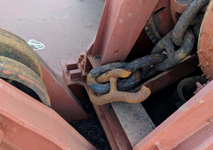
Broken anchor chain due to heavy weather
Proximity to hazards is a key consideration when anchoring and a growing concern when heavy weather combines with increasingly crowded offshore waters. The windfarm in the above case was around 2 miles from the anchorage and the vessel’s rate of drift reached 5 knots. Other offshore surface and subsea structures continue to occupy more space and in another case, two large container ships dragged anchors across an oil pipeline leading to serious pollution. The investigation found that because of the proximity of anchor positions to the pipeline, the crews had insufficient time and space to heave in their dragging anchors in high winds and seas. Moreover, the boundary of the anchorages did not leave a sufficient margin of safety, one of them being less than two cables from the pipeline. VTS monitoring also failed to detect the danger of dragging at the anchorages they assigned the vessels to. The electronic chart being used by VTS did have a layer showing pipeline hazards, but they were turned off because of excessive clutter.
As in some of the above cases, the time from losing or dragging anchor to contacting the first hazard can be less than twenty minutes. Positional awareness and early detection are therefore essential, especially at night or in restricted visibility. Radar monitoring, GPS drift vectors, ECDIS swing-circle alarms as well as visual bearings are important onboard tools. However, it can still leave very little time for crew to react and immediate actions are needed. Engines must be started without delay, communication with the anchor party (if safe to be deployed) must be prompt and clear, and the ship must be manoeuvred to relieve excessive load on the chain. Attempting to heave the anchor without engine assistance risks overloading the windlass and even in lighter conditions it can take tens of minutes to recover the anchor before the vessel can manoeuvre away from danger. In short – the decision to leave the anchorage must be taken early.
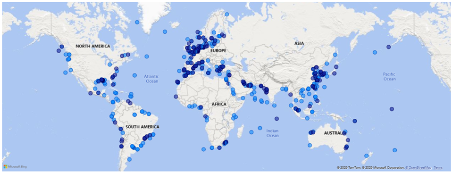
Geotagged anchor-related claims at Gard, 2015-2024. The light blue are Hull & Marchinery anchor claims and the dark blue are P&I anchor removal claims. Source: Gard
Waiting for trouble
A suitable anchorage may not be available, forcing the ship to wait off port. The choice is usually to slow steam or to stop engines and drift. The latter avoids burning bunkers, so it may be commercially preferable. In calm weather and open water this is understandable. However, in heavy weather it may not be prudent as the ship’s motion cannot be controlled, making it prone to heavy rolling. The readiness of the engines and the proximity to hazards are also important considerations.
In this accident investigation the vessel arrived early off port and so it started drifting with the engine off but ready for use in twenty minutes. At that time the vessel was eight miles north of a shallow reef and based on an overseas source the master assessed that forecast Northerly winds of 25-30 knots would not worsen. Unfortunately, after the master left the bridge in the early hours, the wind did gain strength and the vessel closed to within four miles of the reef. It took several hours before the engines were made ready with the master back on the bridge. Perhaps concerned for the load on the engines only half power was used and the vessel found it difficult to turn away from danger. The vessel continued to drift and water depth prohibited use of an emergency anchor until the ship was only one cable from the reef. The coastguard suggested the vessel contact a tug, but none were available. To make things worse, the seabed was coral and not a good holding ground for the anchor. The vessel ran aground shortly after and the crew were evacuated. Salvors removed bunkers but could not refloat the vessel which broke in two in a subsequent storm. The investigation revealed that the master did not consult local forecasts which predicted winds up to 45 knots as well as high waves. His night orders did not require the officer on watch to maintain a safe distance from the reef, nor that he be called if the weather worsened. It also found that a more sheltered drift location was available south of islands associated with the reef.
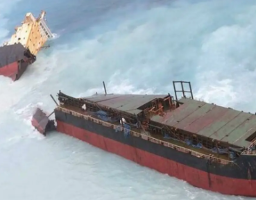
The grounded vessel broke in two in a subsequent storm.
In another accident investigation there was no anchorage available and the vessel chose to drift but used engines to return to the start location well away from a lee shore and other hazards. When an anchorage became available, it was decided to continue drifting despite winds up to 40 knots and waves up to 6 meters. The master’s decision was influenced by how the vessel behaved on two previous drifts, with rolling less than 10 degrees. On the third drift the vessel experienced a large role of over 30 degrees causing containers to be lost overboard. The investigation found that the vessel experienced parametric rolling in conditions making that a predictable risk.
Entering trouble
Similar considerations for entering port in heavy weather apply to those considered previously for leaving port, and commercial pressures may need carefully managing. Beyond the dangers of the port approach, berthing itself presents heightened risk. Accidents during berthing are more common than with unberthing due to the need to control approach speed, distance and angles. These challenges are amplified in heavy weather and especially if combined with tide or current effects.
Ports may set operational limits for entry, but these are often generic and may not take into account the features of a particular ship. In one accident investigation the port did make rather detailed assessments for larger container ships in consultation with pilots and tug operators. The maximum wind speed was set at 20 knots (10-minute average) with maximum gusts not to exceed 25 knots. The earliest port entry was set at sunrise and four tugs were required. The day before the accident the forecast winds were within limits and the pilot was booked. The port received contradictory forecasts on the day of the accident, and one had winds marginally higher than the port limits with an indication of squalls.
Shortly after the pilot boarded a squall passed through with winds up to 47 knots recorded. At the time the ship was in the deepwater channel, but the pilot did not discuss the conditions with the master or when reporting to VTS. Unfortunately, around 50 minutes later a second squall was encountered when the ship was making a turn in the inner channel to enter the port. It affected steerage and despite three tugs being connected, the ship was unable to complete the turn before contacting the quay and a vessel alongside. Fortunately, injuries were minor, though damage was substantial.
The investigation found that numerous factors led to the accident and that the deviations from port entry limits increased the risks. Entry before sunrise made squalls more difficult to detect and the risks associated with winds exceeding limits were not assessed, which may have caused the approach to be aborted before the vessel entered the inner channel. After the accident the port made some improvements to its operational limits, including an earlier tug rendezvous point. At the time the vessel was trying to make its ill-fated turn the fourth tug was being made fast, which increased the bridge team's workload at a critical stage.
Many more incidents have more positive outcomes and so are not the subject of an investigation. They include a cruise ship whose master spoke of winds rapidly gaining strength up to 60 knots after entering port. As the ship was turned broadside and quickly blown towards the berth, the master skillfully deployed the outward anchor and in combination with the engines managed to make a more controlled landing alongside. It is nice to end this series of articles on such a note and with a nod to seafarers who skillfully manage heavy weather risks somewhere in the world every day. Even incidents having relatively low consequences have value in terms of lessons learnt and knowing when mother nature will likely have the edge next time.
Key takeaways
We have seen in this article that knowing the limits are key to managing heavy weather risks, whether it’s the anchor system, the time and space to hazards when anchoring/drifting, or the strength of the wind when entering port. Weather can suddenly and rapidly change and crew need to be ready to react. On other occasions there will be more time to assess risks and options available to control them. As we have referenced throughout this series, that’s where the company ashore can provide valuable support to a busy crew.
Related Articles


Gard is a member of