Heavy weather poses significant risks for vessels in port, from mooring failures to challenges in safe departure. Investigations show how quickly situations can escalate, with serious consequences for the ship and those onboard.
Written by

Mark Russell
Vice President, Global Claims Lead, Safer with Gard
Published 19 February 2026
Understanding the factors that contribute to these risks can make all the difference between a manageable event and a major incident.
Mooring failures
At Gard, we continue to see dramatic heavy weather mooring failures, as we also highlighted in this 2024 Insight article. Last year, a cruise ship breakaway caused passengers to fall from the gangway. Mooring lines that fail are an obvious danger to people and vessels that break away from their berths also endanger other port users.
Preventing mooring failures starts with ensuring that all equipment is fit for use. Mooring lines that have not been inspected or replaced when defective, as indicated by this investigation, can be an accident waiting to happen. On the shore side, it will vary enormously how much interest a port or terminal takes in the mooring arrangement. There may be little regulatory oversight, and shipowners are the ones usually shouldering the consequences of failure. Berth infrastructure may not have kept pace with the increasing size of ships and severity of weather. For example, cruise ships may seek berths close to town, but these facilities may not be up to modern demands.
There have been several instances of shore bollards failing, including in this investigation. It cannot be assumed that all have up to date certificates or are free from defects, and it pays to check whether a berth has any history of breakaway events. Mooring configurations do not always go as planned. The configuration may be sub-optimal, and the limiting wind speed may be set too high. That was the found to be the case in an investigation into a tanker breakaway which happened during loading and resulted in an oil spill.
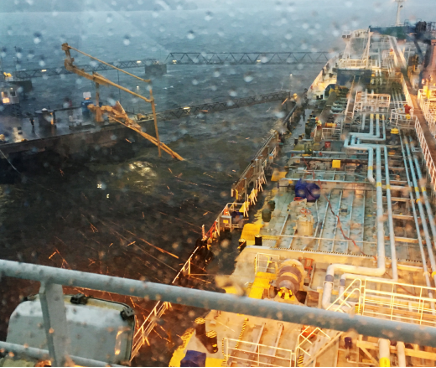
Tanker breakaway from a terminal
For further guidance on limiting wind speeds and best mooring practices, there are several videos produced by the European Harbour Masters’ Committee.
Planning when alongside
Mooring plans should include a back-up, especially for high-sided vessels, light condition vessels and berths that are exposed or located near adjacent hazards. A cruise ship breaking its mornings and colliding with an adjacent tanker makes for a serious situation. In port, more weather forecasts are usually available than at sea, allowing for cross-checking of actual conditions from local met stations. More localized squalls can result in sudden increases and changes in wind direction having a profound effect on sail areas. The ship should clearly define which forecasted conditions will trigger extra control measures.
When heavy weather is expected, the ship can usually take extra measures of its own regarding the mooring lines, winch break settings as well as the use of the anchor, engines or thrusters. However, if conditions are worse than forecast and parted lines in the water prevent use of ship’s power, it may be too late for tugs to save the day. The table below is an example from mooring failure investigations. In the first case, tugs were requested before the breakaway, but the tugs did not arrive in time. In the second case, the request came after the breakaway. In the third case extra measures were taken, conditions were reasonably forecast and within mooring analysis limits. Tugs were immediately requested but they still arrived 15 minutes too late.
| Vessel type | Forecast wind (knots) | Actual wind (knots) | Tugs arrived after first request (minutes) | Tugs arrived after first failure (minutes) |
|---|---|---|---|---|
| Car carrier | Gusting 39 | Gusting 50 | 23 | 8 |
| Bulk carrier | 17-26 | 50-55 | 22 | 25 |
| Drill ship | 30, gusting 44 | 30-35, gusting 45-50 | 15 | 15 |
Prudent overreaction may have seen tugs arriving earlier in these and other cases. Beyond the risk to the ship, there are many tragic examples of mooring line failures resulting in serious injury or loss of life. Other timely and proactive measures are important to protect crew, passengers and visitors. For example, gangway access may need to be suspended and on cruise ships unsecured deck furniture can be turned into projectiles, so deck access may also need to be suspended.
Even after heavy weather has passed, a mooring system may remain exposed. The danger may lurk below in the water, so less obvious to the crew. Heavy and continuous rains that feed river systems to the sea can affect berths along the way with abnormally high currents. Examples include breakaways in the Brisbane River in May 2022 and these occurred despite a similar incident earlier that year. A greater awareness of this risk is important as it allows the ship to stay alert to warnings from local authorities and to take timely steps.
When leaving port
It is not uncommon for a terminal or port to order a vessel to leave the berth to avoid heavy weather damaging the ship or port infrastructure. Just as with mooring breakaways timing can be crucial and a proper early risk assessment as opposed to a rushed one can make all the difference to the outcome. This is again where the company ashore can provide vital support to the ship. The master may be placed in a difficult situation, feeling that safety concerns are not given sufficient weight. Contact with local authorities, perhaps through the charterers, may help to gain a fuller appreciation of the available options. It helps to quickly determine who the decision makers are, what the process is and what tools they use to make assessments. The status of the ship and whether it has fully functioning machinery and equipment will be important considerations. Class or the Flag state may need to be notified and have something to say. Even with everything in working order, there may not be enough time to address risks associated with reduced propellor immersion or cargo susceptible to shifting.
Remaining in port, perhaps at a more sheltered location, could lead to some damage. However, it may avoid the risk of losing control when leaving the port, which could lead to more serious consequences. The decision may come down to factors such as the difficulty of making a large turn, especially for vessels with a large sail area, or the ability to steam far enough away from shallow waters and to “heave to” in the absence of a sheltered and suitable anchorage. Getting from the berth to the place where the vessel will see out the heavy weather needs careful consideration in the passage plan. Safety margins for likely weather effects will need increasing and it is good to have something spare. Suitable tugs may not be able to assist or arrive in time if problems arise. Before the ship leaves, the Master Pilot Exchange may offer a final opportunity to check that the whole bridge team knows the plan and the contingency measures in case the ship gets into difficulty.
The effects of heavy weather can also lead to adverse loads on the engine and an inability to maintain sufficient power. A near-grounding investigation is a good example of things not going to plan when it was decided the vessel should leave port due to heavy weather. In this case, VTS advised that the anchorage was closed and that ships drifting off the port should keep a safe distance of around 12 miles. The ship lost power in conditions worse than forecast, resulting in a drift rate of 4 knots toward a lee shore, leaving only three hours before grounding. Attempts were made to fix the engine before external calls were made for help. Fortunately, sufficient water depths meant the anchors could be used as a last resort, stopping the ship only cables away from rocks and buying vital time to consider crew evacuation. When help arrived, the tug’s tow line parted and the ship once again had to deploy emergency anchors. By the time professional salvors and more tug support arrived, the ship was encountering seas of 9-12 metres. The investigation found that communication and coordination failures hindered the response, despite plans being in place. The company’s own SMS emergency procedures sensibly called for a greater safety margin from navigational dangers of 20 - 50 miles in adverse weather, to ensure sufficient time to respond to contingencies such as machinery failures.
A state-nominated emergency towage vessel (ETV) was fortunately available to help in the above case. The absence of that capability was noted in another investigation where the ship was not so fortunate, resulting in a grounding and wreck removal. The vessel was a heavy lift ship delayed in leaving port ahead of a typhoon to seek shelter some distance away. The oversized deck cargo and heavy weather contributed to the ship only being able to achieve half power and the crew abandoned ship. Given the difficulties faced by vessels in cases like these, prudent overreaction may have involved consideration of whether it was possible to stay somewhere in port.
Key takeaways
In both of the above scenarios, port activity can make it more challenging for the crew to monitor the weather and assess risks so that measures can be put into place in good time. Support from the company ashore can make all the difference and may need to go beyond the initial risk assessment. This may include contacting relevant authorities and arranging contingencies such as suitable and timely tug support. Early notification to the company allows all available options to be explored.
In our next Insight article, we will look at heavy weather risks for ships on passage.
Related Articles


Gard is a member of